Burlington, Iowa
We continue on to Burlington, Iowa, where we drive down the crookedest street in the world before a tour of the town.
Dad and I had to make one more stop before leaving Davenport, Iowa: Lower Lindsay Park, situated on the Mississippi River. It includes a display of a dozen or so characters from A Sunday Afternoon on the Island of La Grande Jatte, a painting by Georges Seurat that we had seen at the Art Institute of Chicago on our Eastern Midwest Baseball Road Trip the previous year. As a teenager, I was more than a little obsessed with Steven Sondheim’s musical based on the painting, Sunday in the Park with George, starring Mandy Patinkin and Bernadette Peters.
The colorful fiberglass characters were first created in 2000 and are displayed from spring until fall. It was fun to see this rendition of the painting in a park thousands of miles from its original inspiration near Paris.
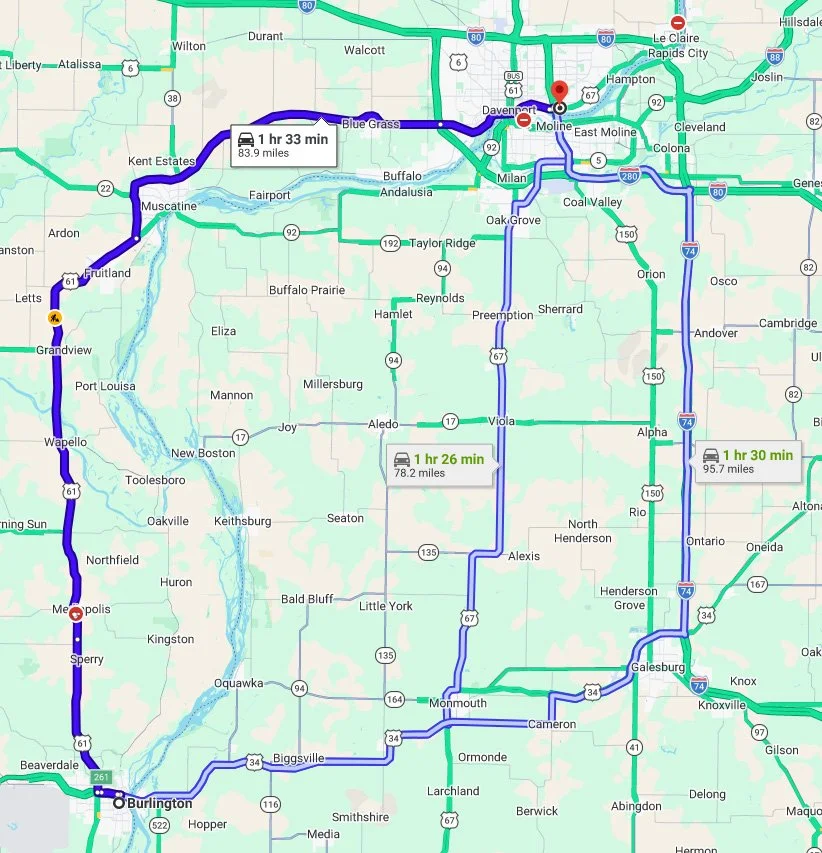
Then we were off to Burlington, Iowa. There are a few routes you can take from Davenport to Burlington. The shortest involve traveling across the Mississippi into Illinois, but we held true to the spirit of a Western Midwest baseball Road Trip and remained west of the Father of Waters.
Our drive took us south down rural Highway 61. A light mist sprayed over us — occasionally strengthening to a drizzle — for a good portion of the drive. But the rain didn’t seem heavy enough to endanger that night’s game with the Burlington Bees.
Along the way, we found the tallest cornfield we would see on the entire road trip — about two feet high. It was still too early in the season for the wall-to-wall cornfields we had envisioned when planning our journey through Iowa.
Snake Alley
When we arrived in Burlington, we headed straight for its most famous tourist attraction: Snake Alley, a winding, brick road that was called the “Crookedest Street in the World” by cartoonist and traveler Robert Ripley (of Ripley’s Believe It or Not!) when he visited Burlington in the 1940s. The street was built with switchbacks in 1894 so that horse-drawn carriages could safely make their way down the steep hill. Snake Alley is only 275 feet long but features five half-curves and two quarter-curves on a 21 percent grade. It’s considered to be slightly more crooked than the much more famous Lombard Street in San Francisco.
We inched through the the twists and turns, then continued down to the Mississippi at the Port of Burlington, where we could see the single-tower Great River Bridge against gloomy skies.
Lunch at the Drake
Our selected lunch spot, The Drake, was close by. It sits just two blocks from the first permanent cabin built in the area by European settlers in 1834. The original town plan was laid out that year, too. In 1837, Burlington was made the capital of the Wisconsin Territory — a fact that could win you a bar bet — then made the capital of the new Iowa Territory the following year.
The building where The Drake now stands was built in 1906 as a new home for Drake Hardware, which would become one of the top hardware stores in the Midwest, serving customers from the Appalachians to the Rockies. It ceased operations in 1980, and the owners of the current restaurant bought the property three years later.
The restaurant’s ambiance includes bits and pieces from all over the area — double doors using salvaged timbers dating to 1860, windows from the local YMCA, and a large mirror dating to 1890 from a tavern in nearby Mediapolis.
Dad had his French Dip and was underwhelmed by having it placed in a hot dog bun. I tried the Grouper Rachel, which is a bit like a Reuben but substitutes sauerkraut with coleslaw and, in this case, fried grouper for the pastrami or corned beef. It was pretty disappointing, as well.
Art Center of Burlington
We did not have a museum on our itinerary, but we did take time to see a gallery — the Art Center of Burlington, right at the heart of the renovated downtown area. The paintings were generally pleasant, made more notable through the use of elaborate frames.
Around Burlington
When the state capital moved from Burlington to Iowa City in 1841, Burlington had already been established as a major early center of political and commercial power in Iowa. This was just eight years after the end of the Black Hawk War against the Native American Sauks, Fox, and Kickapoos — which included both Abraham Lincoln and Jefferson Davis — that kicked off American settlement of the region.
Like so many Midwestern towns on the Mississippi, the arrival of railroads boosted Burlington’s growing commercial fortunes, processing and transporting a wealth of local lumber as well as coal from large deposits east and west of the city. And like so many of those cities, transportation and manufacturing contracted significantly by the late 20th century. Since 2000, Burlington’s population has dwindled each year and is now down to around 23,000.
Crapo Park
We continued south of the city to Crapo Park, perched high on the limestone bluffs above the Mississippi. It’s named for Phillip M. Crapo — and bless him for what he must have endured in school with that name — a Burlington banker who donated the land to the city in 1895. The park includes landscaped gardens, a bandstand, limestone terraces and staircases, and sweeping views of the river.
One key landmark in the park is a reconstruction of the Hawkeye Log Cabin, built as a meeting place for the Hawkeye Natives Association — a social club made up of local white men aged 50 or older. The group’s key purpose was to popularize “Hawkeyes” as a name for the people of Iowa, an effort led by James G. Edwards, editor of — you guessed it — The Hawk-Eye.
Nearby, two mounted guns pointed east across the river — you know, just in case those boys in Illinois get frisky.
It was time to check in to our hotel, for Dad to get his afternoon nap, and for me to make preparations for the ballgame that never happened.