Fargo, North Dakota
We make our way across the plains to Fargo, stopping for spaetzle, contemporary art, and the iconic wood chipper before visiting the mall to see the Roger Maris Museum.
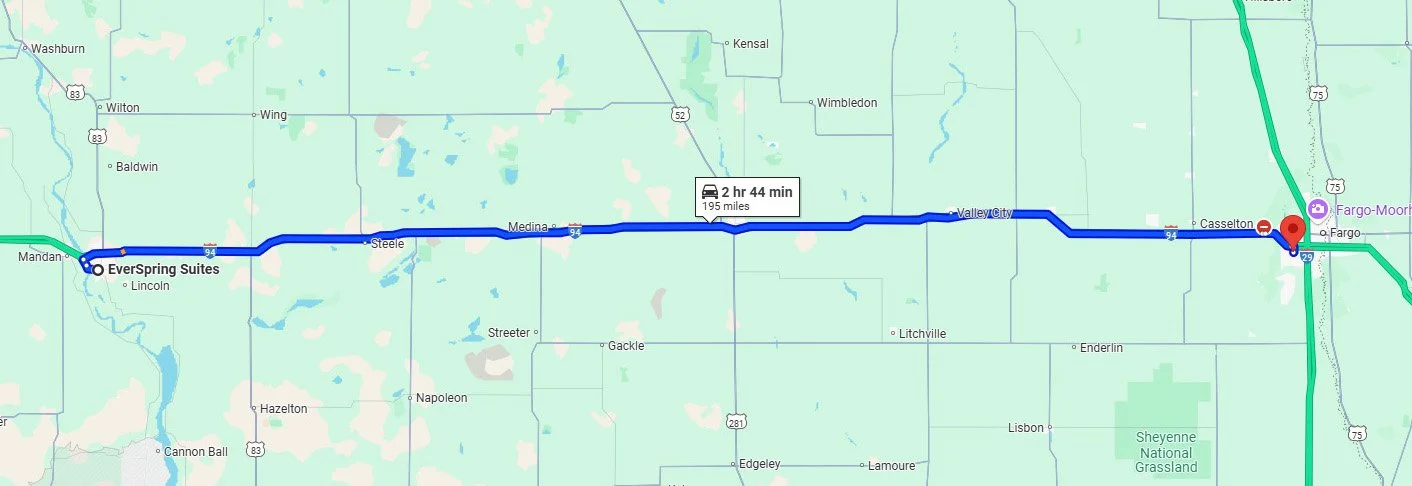
Dad and I gave ourselves an “easy “ morning for our journey across eastern North Dakota, checking out of our hotel at 9:00 a.m. Luxury! We traveled in a nearly straight line across the plains toward Fargo, with the occasional small lake or grove of trees providing the chief points of visual interest. To pass the time, we listened to a few episodes of Strike Force Five! featuring all five American late-night TV hosts and laughed for much of the morning.
Lunch at Würst Bier Hall
We stopped for lunch just west of Fargo in a town called, well, West Fargo. We had selected Würst Bier Hall — one of two locations in the Fargo area — and sat down in comfy stools at the counter, letting our bodies and psyches exhale after the nearly three-hour drive.
Dad had the charbroiled chicken salad, selecting a healthier option amidst our ballpark-heavy diet. I took another approach, doubling down with a Cuban pork sandwich — carnitas, ham, Swiss, pickles, and a mustard aioli — plus a side of spaetzle dumplings, since we were in a region with strong German heritage. It all fit the bill.
Plains Art Museum
Before we reached the heart of downtown Fargo, Dad and I paid a visit to the Plains Art Museum, which showcases the work of contemporary artists.
One of the galleries featured an exhibition called “Ghost Writing,” a mid-career retrospective of Jaque Fragua of Jemez Pueblo, New Mexico, who explores Indigenous identities, histories, sovereignty, and activism. The exhibit invited the viewer “to step beyond passive observation and become an accomplice for Native sovereignty and cultural preservation.”
Jacque Fragua
Jacque Fragua, SOLD OUT, 2016
Jacque Fragua, Big in Japan, 2012
Jacque Fragua, Adobe Sotheby’s, 2018
On the floor below, we saw the work of Anne Labovitz — no, not photographer Annie Leibovitz — who creates immersive pieces that “invite viewers to explore the relationship between art and well-being.” The Minnesota-based artist worked with individuals, community groups, and healthcare professionals to create the works on display at the Plains Art Museum, discussing paths to health and well-being and using those conversations as inspiration for her vividly colorful art.
There wasn’t a lot more to the museum — one gallery space was closed for renovation — but we enjoyed these fresh perspectives.
Around Fargo
Fargo is the most populous city in North Dakota and is 218th on the list in the United States, with a population of about 125,000. It’s on the eastern edge of the state and is frequently teamed up in regional nomenclature with Moorhead, Minnesota, its neighbor just over the Red River — exemplified by our team later that night, the Fargo-Moorhead RedHawks.
Fargo was founded in 1871 and named for William G. Fargo, who established Wells Fargo with Henry Wells in 1852 to provide banking and express services. He later served as mayor of Buffalo, New York, and was a director for the Northern Pacific Railroad, which ran through Fargo.
The Fargo area’s flat, fertile farmland make it a natural fit for North Dakota State University, which excels in agricultural research. It also contributes to frequent flooding from the Red River. A flood in 2009 crested at more than 40 feet and required 85,000 volunteers and millions of sandbags to overcome.
Walk of Fame
We made a quick stop at the Fargo-Moorhead Visitor Center to see the Fargo Walk of Fame — handprints and other cement impressions of famous people who have visited Fargo. The cement pieces had been relocated from a downtown print shop, and many had seen better days.
At the center of this circle of cement was a replica of the wood chipper used to great effect in the movie Fargo. The actual wood chipper is just inside the Visitor Center, but this is a fact I learned only after we sped away.
Roger Maris Museum
Before we reached our hotel, Dad and I stopped at the West Acres Mall. I typically would not write about a trip to the mall, but this one contains the Roger Maris Museum, a unique tribute to the one-time single-season home run king. Just look for the sliding glass doors between Macy’s and Best Buy, and you’re there.
The museum is in Fargo because Maris’ family moved there from Grand Forks, North Dakota, when Roger was in grade school. He graduated from Fargo’s Bishop Shanley High School in 1952 and played his first season of professional ball for the Fargo-Moorhead RedHawks the next year. Just 18 years old when the 1953 season began, Maris hit .325 over 114 games and won the Northern League Rookie of the Year award.
Maris reached the majors in 1957 with the Cleveland Indians, then was traded to the Kansas City Athletics in 1958 and the New York Yankees in 1960. He hit a career-high 39 home runs that first year in New York and won the MVP crown, but everything changed for Roger Maris in 1961, when he achieved the unthinkable: surpassing Babe Ruth’s record of 60 home runs in a season.
In ’61, Maris swatted 61. He also scored 132 runs and drove in 141 more on the way to another World Series ring for the Bronx Bombers. But famously, the season-long odyssey toward the record took its toll on Maris. The pressure of reporters hounding him daily about chasing Ruth, and the boos of Yankees fans who did not want to see baseball’s greatest icon toppled, filled the 27-year-old with enough anxiety that he began losing hair.
After the 1966 season, Maris was traded to the St. Louis Cardinals, where he won two more World Series titles. He later said the trade was a great relief and probably extended his life.