Sioux City, Iowa
It’s onward to Sioux City, Iowa, to discover the city’s connection to the Lewis and Clark Expedition and learn more about the history of Siouxland before sitting down for TV and radio interviews.
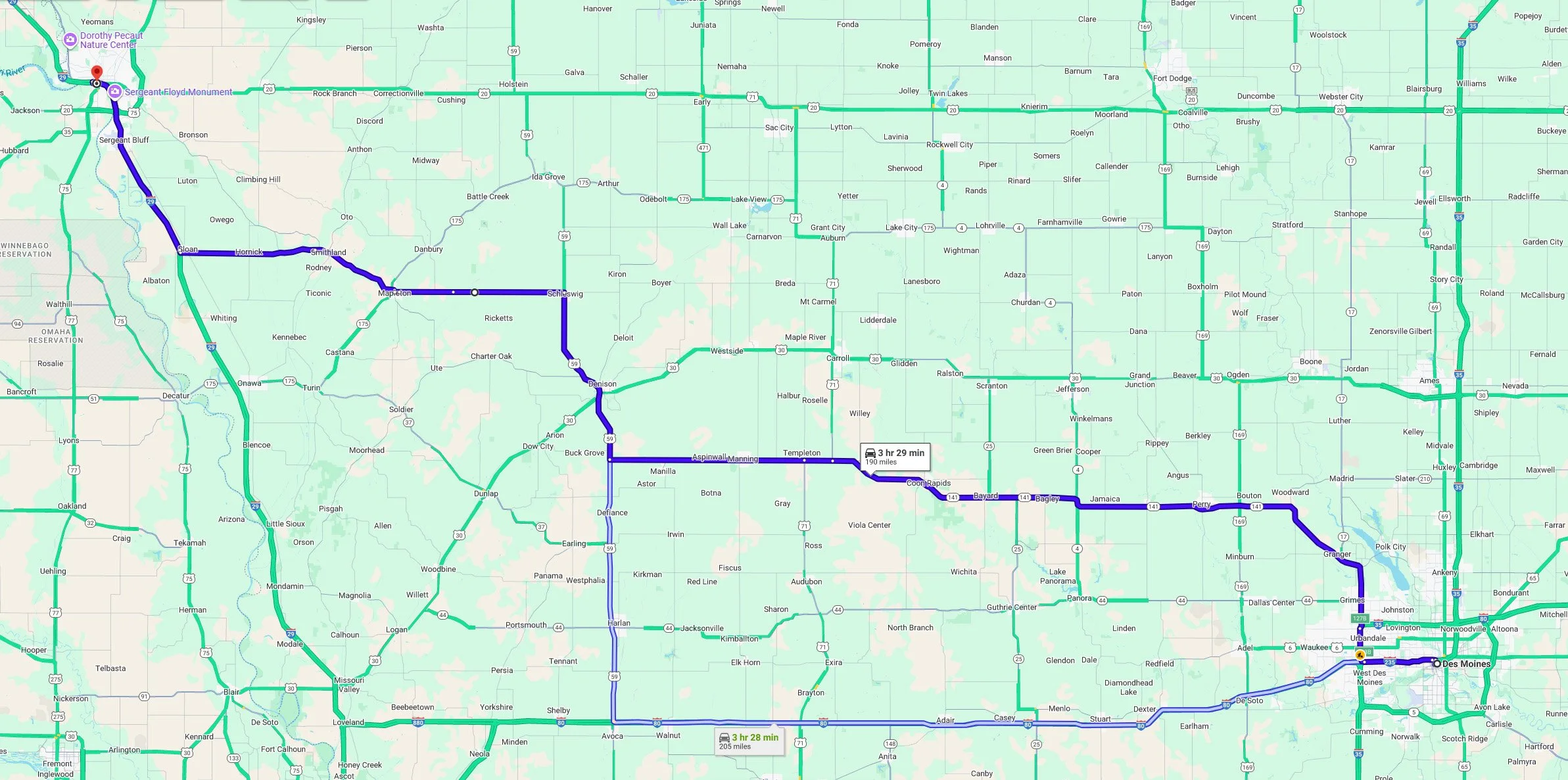
Dad and I were back on the road at 7:30 a.m., heading west in soft morning sunlight. Anthony Mitchell, the Sports Director at KCAU-TV in Sioux City, Iowa, and Sioux City Explorers broadcaster Dan Vaughan had reached out to me to ask if we could meet up that afternoon to record interviews for their respective broadcasts. Of course, we said yes, but this meant some combination of A) removing a sight from the schedule, B) removing Dad’s nap from the schedule, C) taking the interstates instead of the more scenic rural highways, D) doing none of that, getting up earlier, and shifting things around to make it all work. We picked D.
And so we enjoyed our morning drive through endless fields of corn stubble, with some new plantings peeking timidly inches above the soil. We wished it were later in the season, in full bloom, with neat rows towering over the blue highways in starchy splendor.
We listened to podcasts along the way, including a Baseball by Design episode on the Explorers, in which host Paul Caputo interviewed Vaughan — a good primer for us — and Kristine Bornholtz of the Lewis and Clark Interpretive Center — which, as it happened, was our first stop of the day.
Sioux City & Lewis and Clark
With a population of about 86,000, Sioux City is the fourth-largest city in Iowa. It presses up against the corners of both South Dakota and Nebraska, where the Big Sioux River meets the Missouri. It was home to the Yankton Sioux and Omaha tribes, and the larger, tri-state metropolitan area is known as “Siouxland.” The first European settlers were French fur traders in the 1850s, and five years later, the U.S. government sent a surveyor to plan a new town on the commercially and strategically vital Missouri River.
In 1804, the Lewis & Clark Expedition reached this area and stopped along the bluff south of the present-day city. Sergeant Charles Floyd, a member of the “Corps of Discovery,” was gravely ill and soon died of what is believed to be acute appendicitis — the only death for the expedition’s entire journey to the Pacific and back. Floyd was buried on the bluff, but more on that later.
We pulled off Interstate 29. Then I turned left too early, and we rejoined the interstate heading back the way we came. There was some irritated muttering about wasting precious time. And, at last, I returned to make the correct turn to the Lewis & Clark Interpretive Center.
Amongst the museum’s artifacts and informative displays, animatronic figures tell the story of the expedition and its time in Sioux City — of Thomas Jefferson calling for western exploration, of Lewis and Clark and the doomed Sergeant Floyd, and of the enslaved African-American York, whose prowess in caring for the sick earned him the nickname “Big Medicine.”
Lunch at Famous Dave’s
Months ago, we had selected our lunch spot in Sioux City in an email thread discussing ratings, vibe, descriptions, and commentary distilled to a handful of recommendations, with Dad picking the winner. We do this for every meal of every road trip as we walk through each step of the journey together — sights, eateries, seating at ballparks, and other plans. It helps us make the most of our time during the trip and keeps us connected for the rest of the year.
Our analysis produced some quality decision-making in our selection of Famous Dave’s BBQ for lunch — part of a chain, yes, but our first time, and worth it.
I had the Manhandler: chopped pork, bacon, coleslaw, and “hell-fire” pickles. Dad had the same — calling them “zippy pickles” — but with brisket and hot link sausage as the meats. They were an absolute mess — and fantastic.
The Sioux City Art Center was just across the street, the kind of place we like to check out. But our dance card was full for the afternoon.
Sioux City Public Museum
We drive further into downtown to the Sioux City Public Museum, a single-story facility packed with artifacts that depict the history and culture of Siouxland.
The railroad boom and growing steamboat traffic on the Missouri made Sioux City a major transportation hub in the region. It served not only commerce but the passage of Americans further west — Mormons seeking salvation in the flats of Salt Lake City; gold miners pursuing fortunes in the hills of Wyoming.
The city grew further with the success of its meatpacking industry in the 1870s. The Sioux City Stock Yards, which opened in 1887, grew to be one of the largest yards in the nation and drove the economy for decades. By 1910, Sioux City had 60,000 residents — just 53 years after incorporation. Another sign of rapid growth and urbanization: During Prohibition, Sioux City was known as “Little Chicago” because of its reputation for bootlegging and illegal alcohol.
Sioux City’s economic over-reliance on meatpacking, combined with a nationwide recession and the decline of industry in the Midwest, led to much harder times in the 1970s and 1980s. The city has since diversified, downtown has been revitalized, and investments are being made once again.
Dad and I watched The Spirit of Sioux City, a movie that described this history in much more detail. We then went into the museum, which highlighted the people of the community who helped create its history — inventors, entrepreneurs, industrial workers, journalists, politicians, and local sports stars.
We paid particular attention to jerseys from the Sioux City Explorers inaugural season of independent baseball in 1993, and from the 1952 Sioux City Soos playing in the Illinois–Indiana–Iowa League.
Sergeant Floyd Monument
It was time to head back toward Lewis and Clark Park for our interviews, but we needed to make one more stop along the way.
When Sergeant Charles Floyd of the Corps of Discovery died of acute appendicitis, his remains were placed in a grave on a bluff overlooking the Missouri River. But as the Missouri shifted size and shape over many decades, the bluff that held the gravesite eroded away. In 1901, what remained of Sergeant Floyd’s remains were interred at the base of a 100-foot obelisk higher up the hill. In 1960, the U.S. Department of the Interior designated it a National Historic landmark — the first-ever in the nation.
Pre-Game Interviews
We pulled up into the parking lot at Lewis and Clark Park, which was empty except for a single TV news van from KCAU-TV, an ABC affiliate. In the left-field corner of the ballpark, amongst a deck of group-seating picnic tables, we could see Anthony Mitchell setting up for our interview. Anthony did a nice job of making us comfortable and asking smart questions — you can watch his story here.
Next, Dan Vaughan set up across from us with his recording equipment and asked another set of questions to air during his pre-game show. Now entering his 14th season of broadcasting Sioux City games, Dan has also served as play-by-play announcer for the Gary SouthShore RailCats and the Kansas City T-Bones of the American Association. In the off-season, he broadcasts Australian Baseball League games for the Perth Heat from his home in Texas. And his work for the Explorers is year-round: While many teams shut down their broadcasting operations for the winter, Dan is out there streaming his Explorers Expresso podcast with news from the team and around the league. He has a motor that never stops.
When we finished the interview, we began to say our goodbyes. But Dan is a natural-born talker, and soon he was telling us about the Explorers’ recent work with the Miracle League, in which players took the field with teams of disabled kids for a few short games. He then described a baseball road trip his dad took with his grandfather to places like Yankee Stadium, Cleveland Stadium, and Crosley Field in Cincinnati, and how he had recently discovered programs from the trip in a forgotten box of memorabilia.
Vaughan talked about how much he enjoys researching baseball history for his “Sioux City Baseball Flashback” podcast segment, which had most recently covered the 1894 Sioux City Cornhuskers, the town’s first league champion. “I've discovered some phenomenal things,” Vaughan said. “In 1894, Sioux City was one of the top 10 train crossroads in America. I mean, obviously, you have places like Chicago, New York, Philadelphia, and Washington. But as far as this part of the country, it was here and Kansas City, the two crossroads going east, west, south, and north up into Canada. So you could get anywhere you wanted to by train here. In 1894, Sioux City went to Pittsburgh and played the Pirates — who were just called the Pittsburgh National League team at the time — and beat them. And the papers in Pittsburgh were pissed. They said, ‘The hayseeds from Sioux City came to Pittsburgh and beat us.’”
Vaughan particularly loves reading the colorful and elaborate descriptions of the reporters who covered these events from a wilder era of American sports. “I discovered crazy things that happened here, like a hobo at the train station who stole the mascot, and it was a pig, and they were searching all over town for this pig. Or one game where the umpires had to be escorted out by the police because they had made a bad call, and the fans were going nuts. It’s just fantastic.”
We did part ways at last and made for our hotel after a long day of driving and sightseeing. We’d get a couple of hours to rest before another game on the road.