
Sioux Falls, South Dakota
We get lost in a maze of cornfields, then return to South Dakota to see Sioux Falls, visiting its eponymous water feature.
Our driving plan to get from Mankato, Minnesota, to Sioux Falls, South Dakota, involved taking Highway 60 most of the way — as always, avoiding the interstate when it’s feasible. It was a gray morning, but our spirits were high. We were excited as always to cover new ground, and we had many miles of rural roads and verdant farmland ahead of us.
We even found cornstalks that had grown to more than a foot high, signaling the onset of summer.
The GPS then suggested that we take a shortcut of sorts on the much smaller Hammond Highway, named for Winfield Scott Hammond, who was Minnesota’s governor in 1915 (but you knew that). Hammond Highway was a nicer stretch of road — quiet, pretty. And then it stopped.
The highway was shut down for paving. The GPS was unaware of this, so it continued to point us down a closed road that looked free of traffic. I wasn’t sure what to do, so I backtracked a little and took a significantly smaller and barely paved road in the same general direction, past acres and acres of farmland. A deer bounded away from us. A bald eagle stood in a field and watched us until we stopped, then took flight from the scene.
I drove much slower to ensure I didn’t find a way to disable the car in the middle of — with all due respect — nowhere. After a few miles, we reached an intersecting road. It, too, was closed for paving. We drove back to where we had turned off and found another country road to try. And again, we came to a dead end, blocked by road work.
I retreated to Hammond Highway once more and drove much further back before trying another route west. The GPS continued to disapprove, insisting that we return to the original blocked road. At length, we made it out alive.
The Falls
We approached Sioux Falls from the north and headed for the eponymous water feature — a series of cascading waterfalls on the Big Sioux River that stretch for a quarter-mile and drop about 100 feet. An average of 7,400 gallons of water moves through the Falls every second.
The water tumbles over fields of Sioux Quartzite, a salmon-pink stone harder than granite, formed more than 1.6 billion years ago. The sun will likely swallow the Earth before the Big Sioux is able to wear down this rock to a smooth surface.
The Falls served as an economic engine for European settlers. Water power enabled early industrial pursuits via gristmills and sawmills, and the arrival of the railroad soon after supercharged the growth of “The Queen City of the West.”
Into Town
We continued south to the center of Sioux Falls, South Dakota’s largest city, with about 225,000 residents. That number was just 100,000 in 1990 — a remarkable rise in a city with such harsh winters. But Sioux Falls consistently ranks high in livability, with a strong job market and affordable housing that have contributed to one of the youngest median ages of any city in the Upper Midwest.
Lunch at Minerva’s
We drove down Phillips Avenue — the city’s “main street” — and parked for lunch in front of Minerva’s, a classy American grill.
We had, of course, scouted the menu months earlier and had selected Minerva’s not only for its pleasant atmosphere but for having both of our favorite sandwiches on offer.
Dad had his French dip with a cup of tomato-zucchini soup. I had my Reuben with potato-bacon soup. It was an hour well-spent.
Arc of Dreams
We drove a short distance to admire the Arc of Dreams, a monumental stainless-steel sculpture created in 2019 that spans about 300 feet across the Big Sioux River. The artist is Dale Lamphere, South Dakota’s Artist Laureate, who created the arc to inspire people to take a “leap of faith” — symbolized by a short gap at the centerpoint of the arc — to pursue their dreams.
Old Courthouse Museum
Dad and I finished our day at the Old Courthouse Museum, an exploration of Siouxland history and culture located in the former Minnehaha County Courthouse. It is an imposing, towering building made of Sioux Quartzite in the Richardsonian Romanesque architectural style — stone-forward, rugged, muscular, medieval Europe meets America — and it’s a perfect match for the city’s unique natural resource. The building’s outstanding feature is a clock tower that rises 165 feet into the air and is a beloved city landmark. Its life as a courthouse ended in 1962, but the building was saved by citizens and converted into a museum in 1974.
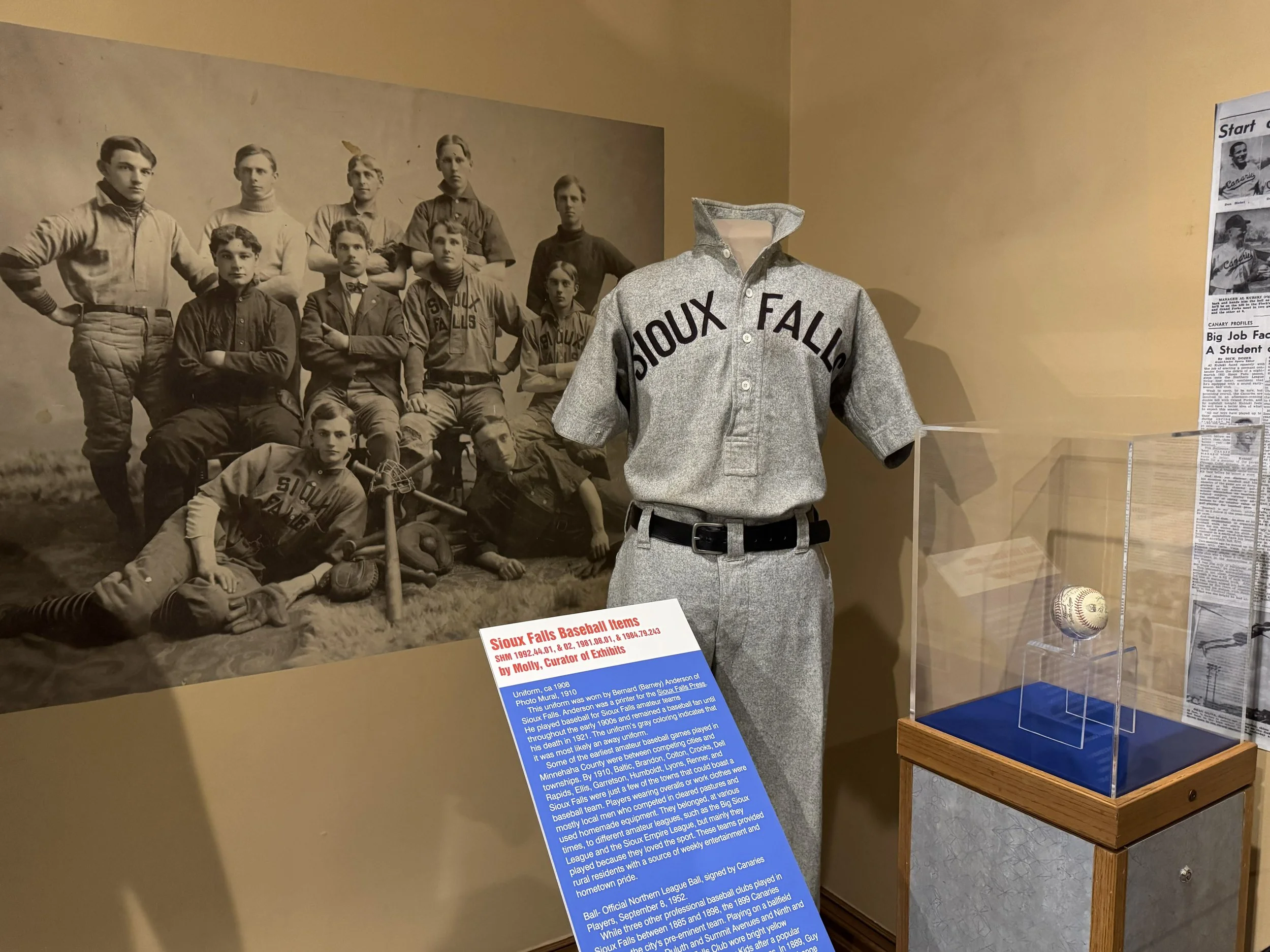
While the museum spans three floors, its space is limited and a bit disjointed. We started on the first floor and were happy to see a jersey worn for a Sioux Falls amateur team in the 1900s, and a baseball signed by the 1952 Sioux Falls Canaries, a Class C affiliate of the Chicago Cubs. We would see the modern Canaries, in the same ballpark used by that 1952 team, later that night.
Depictions of local life included vintage soapbox derby cars and a steel girder sent through a tree stump by a tornado that ripped through town in 1932.
An informative room of displays covering local Native American history and culture was hidden amongst an empty hallway, and I almost missed it. The hallway led to the beautifully restored courtroom and adjoining sitting rooms.
Drive taken, lunch eaten, and sights seen, Dad and I checked in to our hotel to rest up for another ballgame.