Wichita, Kansas
We spend a busy afternoon in Wichita, Kansas, exploring the architecture of Frank Lloyd Wright, an iconic sculpture by Blackbear Bosin, American art, impressive memorials, and the infamous Wichita Troll.
Dad and I pressed on early the next morning with one of our longest drives of the road trip, four hours from Springfield, Missouri, to Wichita, Kansas. Under gloomy skies that let loose a few heavy showers, we traveled on Highway 96 due west toward the Sunflower State. We then took Highway 400 through remote places — full of picturesque farmland and low hills covered in greenery — all the way into Wichita.
Allen House
We paused a little east of central Wichita at Frank Lloyd Wright’s Allen House. Designed by the legendary American architect, the house was built in 1918 for Henry J. Allen, who would become governor of Kansas and then a member of the U.S. Senate representing the state.
Allen House is one of the last of Wright’s Prairie School designs, characterized by low, horizontal lines and earth tones that help blend the building into the surrounding landscape. Wright was also working on designs for Japan’s Imperial Hotel at the time, and Allen House reflects some of those influences, as well.
Frank Lloyd Wright, Midway Gardens Sprite with Baton
The house is open to the public, but it was closed the day we arrived. We missed getting a look at its spacious interior, built-in furniture, custom glass windows, and other artistic touches. But we wouldn’t have had the time anyway: After a four-hour drive, we had plans for lunch and four other sights before resting at the hotel and taking in a game later with the Wichita Wind Surge.
Into Delano
We wound our way through suburban streets across the Arkansas River and into the Delano District, which in the 1870s was separate from Wichita and known for its saloons and sins. This den of inequity was later incorporated into Wichita and now hosts a more respectable avenue of watering holes, restaurants, and shops.
Wichita is the largest city in Kansas, with a population of around 400,000. It began as a trading post in 1860 on the Chisholm Trail, with cattle and agriculture driving a boom in settlements along the Atchison, Topeka and Santa Fe Railway. While it was no Delano, Wichita could be a rough-and-tumble frontier town, attracting lawmen such as Wyatt Earp and Bat Masterson.
By the late 19th century, the city had shifted with the times to become a commercial and industrial center. During the early days of flight, engineers and entrepreneurs invested in Wichita as a major aircraft manufacturing hub. Clyde Cessna (Cessna Aircraft), Walter Beech (Beechcraft), and Lloyd Steerman (Steerman Aircraft) collaborated in Wichita in the 1920s, designing and building planes famous for their reliability and speed. Dubbed the “Air Capital of the World,” Wichita’s influence over the industry continued into the era of jet travel in 1962 when William Lear founded Learjet — a brand that became synonymous with luxurious business air travel.
Lunch at The Monarch
We had plans for more barbecue, but our selected spot for lunch announced a temporary closure, and we had to call an audible. We chose The Monarch, a bustling place in the center of Delano that features local artwork on its walls and more than 100 bourbon selections on its menu.
It was a bit early for bourbon, but we enjoyed a nice lunch and a few moments to relax before continuing with our busy itinerary. I had the Spicy Italian sandwich (Genoa salami, Capicola, ham, mozzarella, giardiniera), while Dad had a taco salad with chicken that drew repeated raves.
Next we drove a few blocks south along the Arkansas to Equity Bank Park — site of our ballgame that night — to take in the Wichita Baseball Museum and the Wichita Wind Surge team store (covered in the next chapter).
Keeper of the Plains
Blackbear Bosin. Mid-America All-Indian Museum
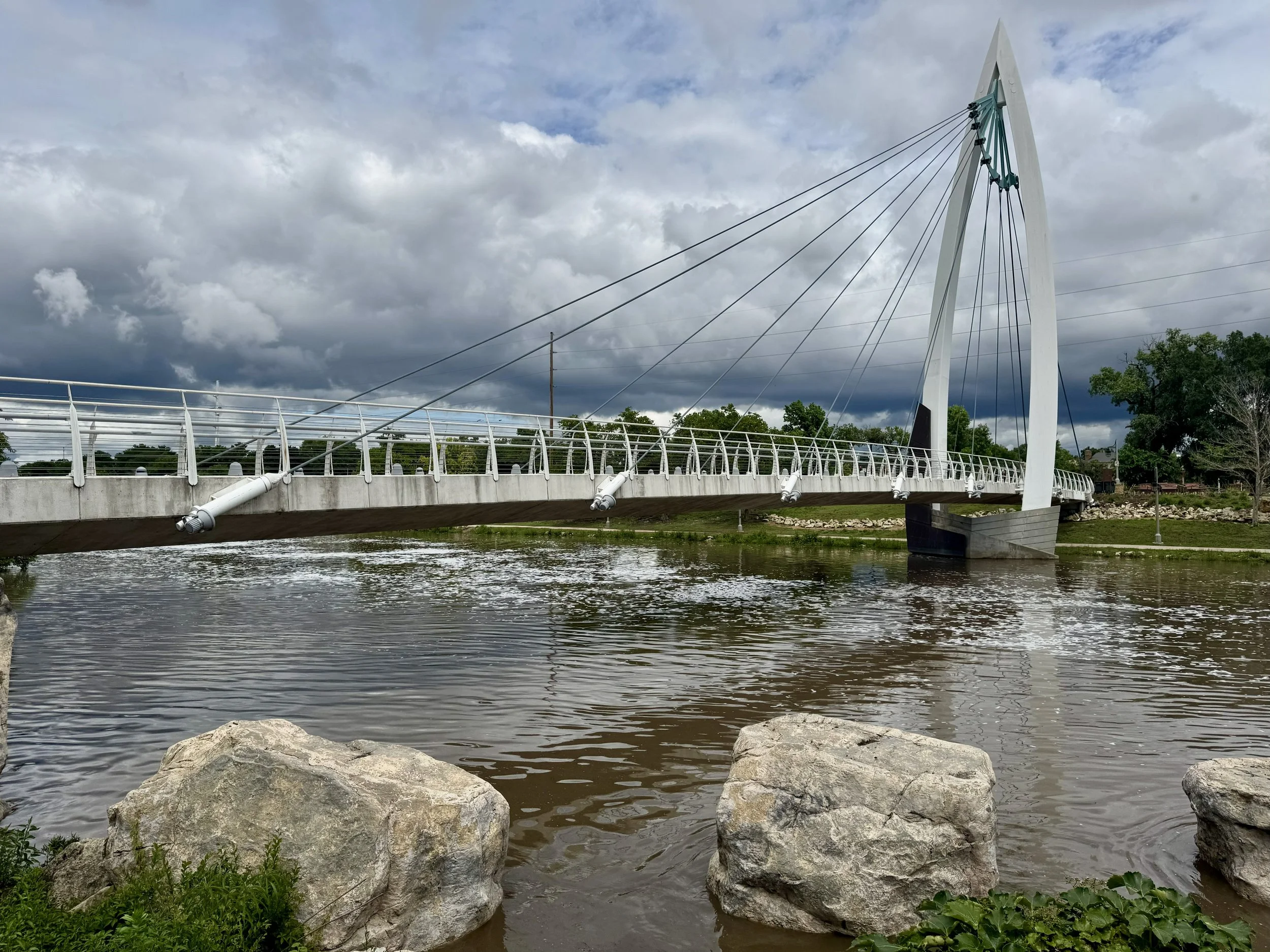
Wichita’s most striking symbol is Keeper of the Plains, a 44-foot-tall steel sculpture by Native American artist and Wichita resident Blackbear Bosin, who donated his work to the city. The statue stands on a rocky outcropping at the fork of the Arkansas and Little Arkansas rivers — a frequent gathering place for the indigenous Wichita people — accessible via footbridges on each side. Dad took photos from the riverside while I walked across for a closer look.
Erected in 1974 as an early contribution to the nation’s Bicentennial celebrations, the monument is meant as a symbol of unity and resilience for the Native community. The Keeper stands tall with hands raised toward the sky, expressing a reverence for and a connection to The Great Spirit, and to nature itself. Fire drums at its base light up nightly for `15 minutes to represent the "sacred hoop" and the four elements of life: earth, air, fire, and water.
“I sincerely hope that this sculpture will always be a reminder to all peoples that we all belong to the earth, our Mother, to the sun, our Father, and above all, to each other and to the Great Spirit,” Bosin declared at the dedication ceremony.
Wichita Art Museum
Dad and I drove just a few minutes further along the Rivers District to the Wichita Art Museum, the largest art museum in Kansas.
Founded in 1935, the museum’s collection has grown to more than 10,000 works, with a strong emphasis on American art from the 18th century to the present — Mary Cassatt, Edward Hopper, Georgia O'Keeffe, and more. I particularly loved Hopper’s simple, mid-century scenes, accentuated by heavy shadows and sharp contrast.
Paul R. Meltsner, Martha Graham Dance Class, c.1939
Edward Hopper, Conference at Night, 1949
Edward Hopper, Sunlight on Brownstones, 1956
N.C Wyeth, The Homesteader, 1930
Francis Blackbear Bosin, Wichita, My Son, 1965
Mary Cassatt, Mother and Child, c.1840
John Steuart Curry, Kansas Cornfield, 1933
Preston Singletary, Origins of Raven, 2019
All museums in America are required by law to display at least one glass sculpture by Dale Chihuly of Seattle, Washington. But his works at the Wichita Art Museum — hung from the second-floor ceiling and embedded under a glass walkway — are particularly good.
Dale Chihuly, Confetti Chandelier, 2003
Dale Chihuly, Persian Seafoam Installation, 2003
Veterans’ Memorial Park
On our way to the hotel, we visited Veterans’ Memorial Park, a collection of military memorials on the east side of the Arkansas River. Monuments scattered along a park trail honor veterans of the Revolutionary War, Civil War, World War I, World War II, Korean War, Vietnam War, and Operation Enduring Freedom in Afghanistan, with special tributes to Prisoners of War and soldiers missing in action, Gold Star Mothers, victims of the Pearl Harbor bombing, the Order of the Purple Heart, the U.S. Marine Corps, the Merchant Marines, Navy Hospital Corpsmen, and the U.S. Submarine Service.
The Wichita Troll
I jogged down close to the river for my final assignment: find the troll.
The Wichita Troll is a public art installation located under a storm grate. Created in 2007 by local artist Connie Ernatt, the seven-foot-tall statue exists without fanfare — no signage, no explanation — as an Easter egg of sorts in the revitalized River District. The troll stands suspended above the water on spindly legs, with outsized ears and a pruny, scowling face staring straight up at the observer like an ill-tempered prisoner of the Public Works & Utilities department.
It’s not a simple thing to see, let alone to photograph. I got down on my knees and pressed my phone to the grate at several angles to capture the beast as best as possible. I kept my grip tight, intensely aware that the phone contained nearly all of the photos and videos of our journey thus far.
I turned to see a trio of boys watching me, whispering to one another and snickering. I felt compelled to respond to claw back some dignity. “The troll,” I said, pointing down. “Have you seen it?”
It seemed they hadn’t. Though they inspected the statue as I left the area, the boys did not find it interesting. Its enchantments evidently spent, the troll was left to stew in its musty cell on the Arkansas.