Pierre to Bismarck
We spend an early morning seeing the capital of South Dakota before traveling to the capital of North Dakota.
Our late arrival the previous day in Pierre, South Dakota, meant we needed to make an early morning start for a quick tour of the city before we set out for Bismarck. But “early” meant 7:30 a.m., and there wasn’t much happening in the older commercial district at that time on a weekday. Restaurants and shops wouldn’t open for hours. Combined with seeing more than a few storefronts in disuse — including one apparently rented by the Oahe Zap — the area felt lifeless and abandoned.
But that’s on me. My careless error in calculating the previous day’s drive had not only made that day more stressful, but it had cascaded into the next day, so that we were now on the move — and attempting to evaluate Pierre’s historic center — much too early amidst a marathon road trip. I should have my National Planning Association membership card suspended.
Pierre is named for Pierre Chouteau Jr., a key player in the Missouri River fur trade that had pushed into this region by the early 1700s. Fort Pierre was established on the other side of the Missouri in 1817 and became one of the most important trading posts on the river, as well as a hub for diplomatic relations between the Americans and the native Lakota Sioux.
When South Dakota achieved statehood in 1889, legislators selected Pierre as its capital — in some measure, because it’s smack dab in the middle of the state. It had fewer than 2,000 residents then, and has just over 14,000 residents today.
Trail of Governors
Our time in Pierre was brightened by the bronze statues scattered throughout the city representing all 31 former governors of South Dakota through 2022. Each statue has been given a pose and occasional props to express the spirit of the governor it honors — from uncompromising Coe Crawford, standing, ready for a fight; to road-builder Peter Norbeck with a surveying tool; to Archie Gubbrud, who made the state a Cold War hub for rocket research, admiring a model of a missile.
Gov. Arthur Calvin Mellette (1889-1893), first governor of South Dakota
Gov. Coe I. Crawford (1907-1909)
Gov. Peter Norbeck (1917-1921)
Gov. Thomas Matthew Berry (1933-1937)
Gov. Archie Gubbrud (1961-1965)
Gov. Nils A. Boe (1965-1969)
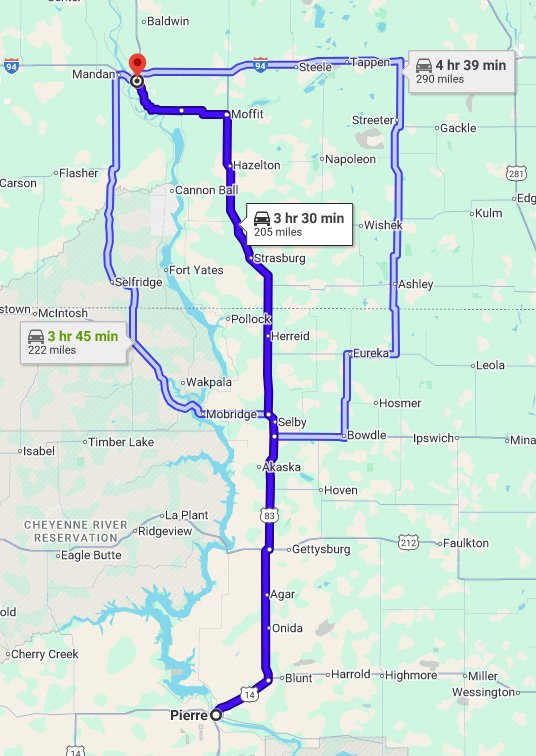
Dad and I soon settled in for a three-and-a-half-hour drive due north through mostly flat farmland, running parallel to the Missouri River about 10 miles to the west. It was still pretty early, and our psyches were not quite ready for information, so we skipped the podcasts and listened to some music — Talking Heads, The Beatles, Traveling Wilburys, The Police…
About an hour in, I received a message from Ben Dackiw, Sports Director for KFYR-TV in Bismarck, to arrange an interview with us at the ballpark that night. That sounded fun, but gathering collections of dark clouds threatened to dampen our evening with a rainout. I watched a storm approach on my weather app, then frowned as it poured for about 30 minutes. Dramatic lightning strikes nearby raised the tension.
It remained cloudy the rest of the day, but the rain at least stopped. As we rolled into Bismarck, we appeared to have a good shot of getting our game in with the Bismarck Larks later that night.
Lunch at Walrus
We pulled into a strip mall for lunch at Walrus Restaurant. On this beef-and-pork-heavy ballpark trip, I mixed in a very good Santa Fe Chicken Sandwich and an excellent tomato-basil soup, paired with a Toppling Goliath Sosus Double IPA. Dad liked his roast beef and Swiss wrap that the restaurant calls “Thor.”
North Dakota State Capitol
We made our first proper stop in Bismarck at the North Dakota State Capitol, a 21-story Art Deco tower completed in 1934. Known locally as the “Skyscraper on the Prairie,” the Capitol is more than 241 feet high, making it the tallest habitable building in North Dakota. It replaced the original Capitol, a Gothic Revival structure that burned down in December 1930.
North Dakota Heritage
We drove just around the corner from there to the North Dakota Heritage Center & State Museum, which covers nearly 600 million years of natural and cultural history.
The museum has a solid focus on early geology and prehistory, and rightly so. For hundreds of millions of years, much of North Dakota lay under a shallow ocean. It’s wild to see marine fossils from this time and think of an ocean covering a portion of the Upper Midwest. Over millennia, the seas retreated, and dinosaurs emerged from the swamps, beginning to flourish about 70 million years ago.
We procured a scooter for Dad, which he enjoyed greatly as we made our way through displays covering early human history in North Dakota dating back about 13,000 years. The Sioux tribes of the Dakota, Lakota, and Nakota ranged across the state hunting buffalo, while tribes like the Mandan, Hidatsa, and Arikara settled in villages along the Missouri River, sustained by the adoption of agriculture.
The museum includes photography celebrating the rich natural landscapes of the state and some of its more iconic fauna.
We ended our tour in a large hall called the Inspiration Gallery, which showcased historic and cultural artifacts from the past 150 years of life in the North Dakota: tractors and siloes representing agricultural innovation; tools and methods to extract crude oil; the development of railroads and automobiles that brought new growth; the dress and customs of Native Americans and its immigrant communities; and life during the Cold War, represented by a nuclear fall-out shleter and a missile silo command center.
Downtown Bismarck
Afterwards, we cruised up and down the streets of downtown Bismarck, looking for something that might catch our attention before we checked into our hotel. We came across the Northern Pacific Railroad Depot, a Mission-style building completed in 1901 and currently undergoing restoration. The structure was designed by famed architect Cass Gilbert, whose other works include the U.S. Supreme Court Building, the St. Louis Art Museum, and the state capitols of Minnesota, Arkansas, and West Virginia.
We drove a few blocks further to our hotel for the night, the EverSpring Suites. I left Dad in the car as I walked into the hotel to check in. The place looked different than the photos I had seen online — older and more ragged. I stepped up to the counter, and the man working there checked my identification, then checked his records. He said he could not find our booking. Instantly worried, I produced a printout of my confirmation email, which he checked briefly before saying, “This is a different hotel. We are in the EverSpring Inn. You are in the EverSpring Suites, next door.”
Amused and a little relieved, I went back to the car and pulled it around to the correct hotel to begin our daily pregame respite.