Oahe Zap
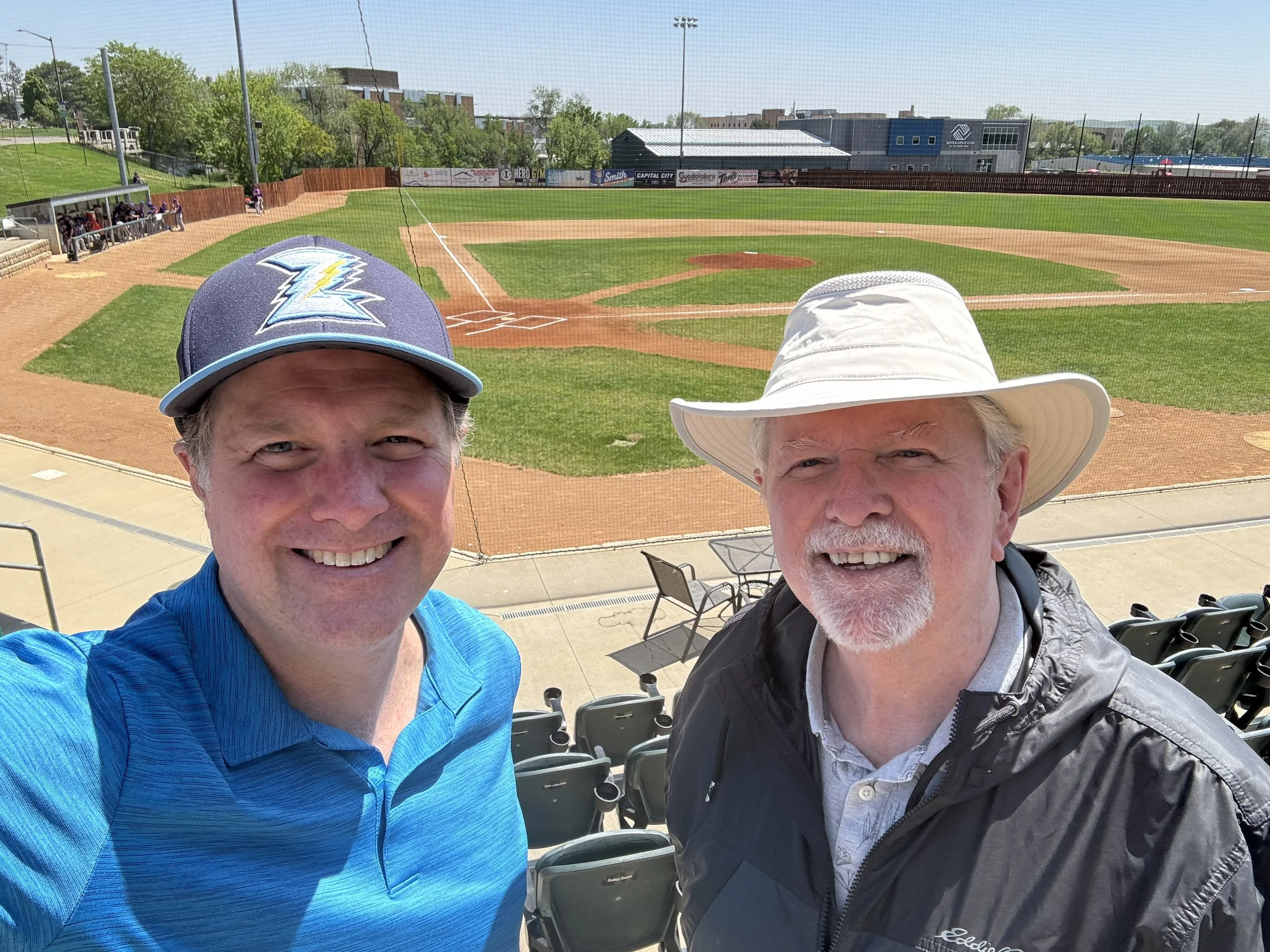
It’s Zap vs. Moo as Dad and I visit Hyde Stadium in Pierre, South Dakota, to see a collegiate Independence League game between the Oahe Zap and the visiting Fremont Moo.
Dad and I came into Pierre a bit hot. I had managed to make up some time on South Dakota’s Interstate 90 after discovering my route calculations were off by a full hour — a crime of hasty addition committed months before. We had been ahead of schedule; now we were behind. I don’t really enjoy being behind schedule.
We cruised through Fort Pierre — the smaller sibling to the capital city, on the south side of the Missouri River — then crossed into Pierre and drove urgently to our ballgame. We like to get to our ballparks when the gates open to see as much as possible before the first pitch. It was fortunate that our venue for the day was the smallest we’d see on this trip: Hyde Stadium, built in 1935 and home of the Oahe Zap, a collegiate summer league team playing in the Independence League.
Organized baseball in Pierre began in earnest with the Pierre Cowboys, established in 1953, 18 years after Hyde Stadium was built. The Cowboys were charter members of the Basin League, an independent semi-pro league. It had become a collegiate summer league by 1973, when it and the Cowboys folded.
Pierre’s next baseball opportunity came 45 years later in 2018, when the eight-team, collegiate Expedition League began play and included the Pierre Trappers and Hyde Stadium. The league had added a few more teams by 2021, when seven clubs defected to form the Independence League. The Trappers stayed behind. Down to just four teams, the Expedition League foundered and folded in 2022.
The Zap were created as an Independence League team the following year.
Hyde Stadium, known as the “crown jewel of sports in Pierre,” was built in 1935 as a Works Progress Administration project in a partnership between the Charles L. Hyde family, the Federal Emergency Relief Administration, and the Pierre City Commission. It has undergone many renovations and upgrades since.
We had tickets in the bucket seats just to the right of the covered cement seating area behind home plate. But it was simply too hot — 87 degrees, officially — to sit directly in the sun. Despite his bad back, Dad chose the cement seats in the shade.
Two couples behind us had also retreated from the sun-fried bucket seats to the shade. As we told them about our road trip and our day in southern South Dakota visiting my grandmother’s birthplace in the tiny town of Lesterville, one of the men said that his mother also had been born in Lesterville.
The team store was being run out of a Pepsi-branded trailer on a little plaza inside the front gates. The Zap have a color scheme made for merchandising, with powder blue set against navy blue, and the occasional shock of yellow.
Options included jerseys and hats for the Oahe Chislics, an alternate identity celebrating a South Dakota dish featuring skewered cubes of meat — typically lamb or mutton — that are either deep-fried or grilled, and served with Saltine crackers and perhaps a dipping sauce.
I got the hat I came for — a two-color beauty. There weren’t any logo baseballs for sale, so Dad picked up an ice cream helmet for his collection.
Oahe had struggled in the first week of the Independence League season, starting with just two wins in seven games. One of those wins had occurred the night before against the the Fremont Moo — their opponent for our ballgame — when the game was stopped due to the 10-run rule with the Zap ahead 13-2 after seven innings.
The Moo — based northwest of Omaha in Fremont, Nebraska — had started the season with a 3-3 record. Both teams would finish the 2025 campaign with records just under .500, with the Zap edging the Moo by a half-game.
Zap PA announcer Dylan Beach — aware of our trip through social media — spotted me, introduced himself, and handed me a bobblehead of Shock, the Oahe mascot — a pleasant surprise. Shock himself arrived soon after and was the real hero of the day, entertaining fans energetically in a hot and heavy costume.
Lineup cards were shared, and Miss Oahe Teen Volunteer 2025 Kaylee Tostenson sang the national anthem. A lively little crowd had gathered, collected in the shade of the cement seats in a 90-year-old ballpark, ready for a Sunday afternoon of baseball.
The game began with a scoreless first inning, belying what was to come.
I stepped up to the concession stand on the first-base side and ordered cheeseburgers for both of us. They were grilled fresh outdoors and worked just fine for the occasion.
As I made runs to and from the concourse, I came across Oahe General Manager Alex Sheetz, who chatted with me for a bit. I hoped that he appreciated my choice of shirt for the day — an effort to connect to the Zap color palette.
The Oahe offense came to life in the second inning and never really let up. They scored two runs in the second, three in the third, and three more in the fourth, powered by five doubles. Meanwhile, a trio of Oahe hurlers held the Moo lineup to just one hit and no walks. The Zap were on top 8-0 after four.
Fremont got on the board in the top of the fifth with a run on two hits — the last hits they would collect on the day. The Zap responded with two more runs — their fourth straight inning of crooked numbers — and led 10-1 going into the sixth inning.
As the warm sun passed through the cloudless sky, shade emerged at the edge of one of the seating sections featuring bucket seats. Knowing Dad’s discomfort sitting on the cement, I led him over to the shadiest empty bucket seats and fetched us lemon icees to help cool down.
Neither team scored in the sixth, but there was a new tension: Could Oahe win back-to-back games via the 10-run rule? They would need to be ahead by 10 runs or more at the end of the seventh or eighth inning.
We started chatting with some folks behind us and discovered that one of them was Bob Habeger, part of the Zap ownership group that includes his son Jamy. He was wearing an excellent button-up shirt patterned with a baseball scorebook. We talked about our trip and how we would be staying in that night to do laundry. Bob recommended a local launderette in case we needed it.
Bob seemed to be rooting for a game shortened by the 10-run rule— not just to get a win in the books but to get out of the heat. We could all relate.
The Zap obliged — as did the Moo, who helped turn a single, a wild pitch, an error, and a sacrifice fly into the winning run and an early evening for everyone. Oahe won it 11-1 in seven innings.
South Dakota State Capitol
On our way out of the ballpark, we stopped at the South Dakota State Capitol, built between 1905 and 1910 in a Neoclassical/Renaissance Revival style.
The South Dakota Department of the Military and Veteran’s Affairs faces the capitol with a more classical façade.
We drove back to our hotel in Fort Pierre, and Operation Laundry commenced.
Dad and I have two laundry days per road trip. These are scheduled exactly when they need to occur, given our busy itinerary. So when it’s time to do the wash — in this case, immediately after our ballgame with the Zap — I get very focused. Because there are only so many washers and dryers in a hotel, and if someone gets their load in before yours, it could cost you an hour or more. Missing this laundry window would mean a much harder tomorrow.
That’s not how it unfolded (so to speak), I am grateful to report. But I did need to wait for someone else’s load to finish. So I stepped out onto the lawn next to the Missouri River, boisterous and blue on a windy afternoon, and admired the Capitol dome peeking above the cottonwoods on the other side.
With the first wash cycle underway, I picked up dinner at Drifters Bar & Grille, just a little upriver, and enjoyed an IPA while I waited. We ate happily in the hotel room as I trotted up and down the stairs to finish the laundry and get us to bed early. The next six nights would be all about baseball.