Southern South Dakota
We drive into South Dakota to explore the towns where our Czech ancestors settled, then make a trip to “The World’s Only Corn Palace.”
We gassed up at a Casey’s near the hotel around 8:15 a.m. I marveled at the price per gallon — $2.59 for super unleaded, about half of what it would cost back home in the Bay Area of California. I snapped a photo of the big Casey’s sign at the entrance with proof of the incredible price beaming in neon red. I admired my photo, resolved to send it to my wife later in the day, got back in the car, and drove off with the gas nozzle still attached to my tank.
The car jerked forward, and there was a disconcerting sound of metal doing something it was not designed to do. Who needs coffee when you can bumble your way into an intense state of full adrenaline?
The nozzle and a length of hose had broken away from the pump and were dangling from the rental car. Mortified, I walked into Casey’s to notify someone and apologize. “No big deal,” the guy said, “It happens all the time.”
Relieved, I hustled back to the car to begin another big day of driving.
Tabor, South Dakota
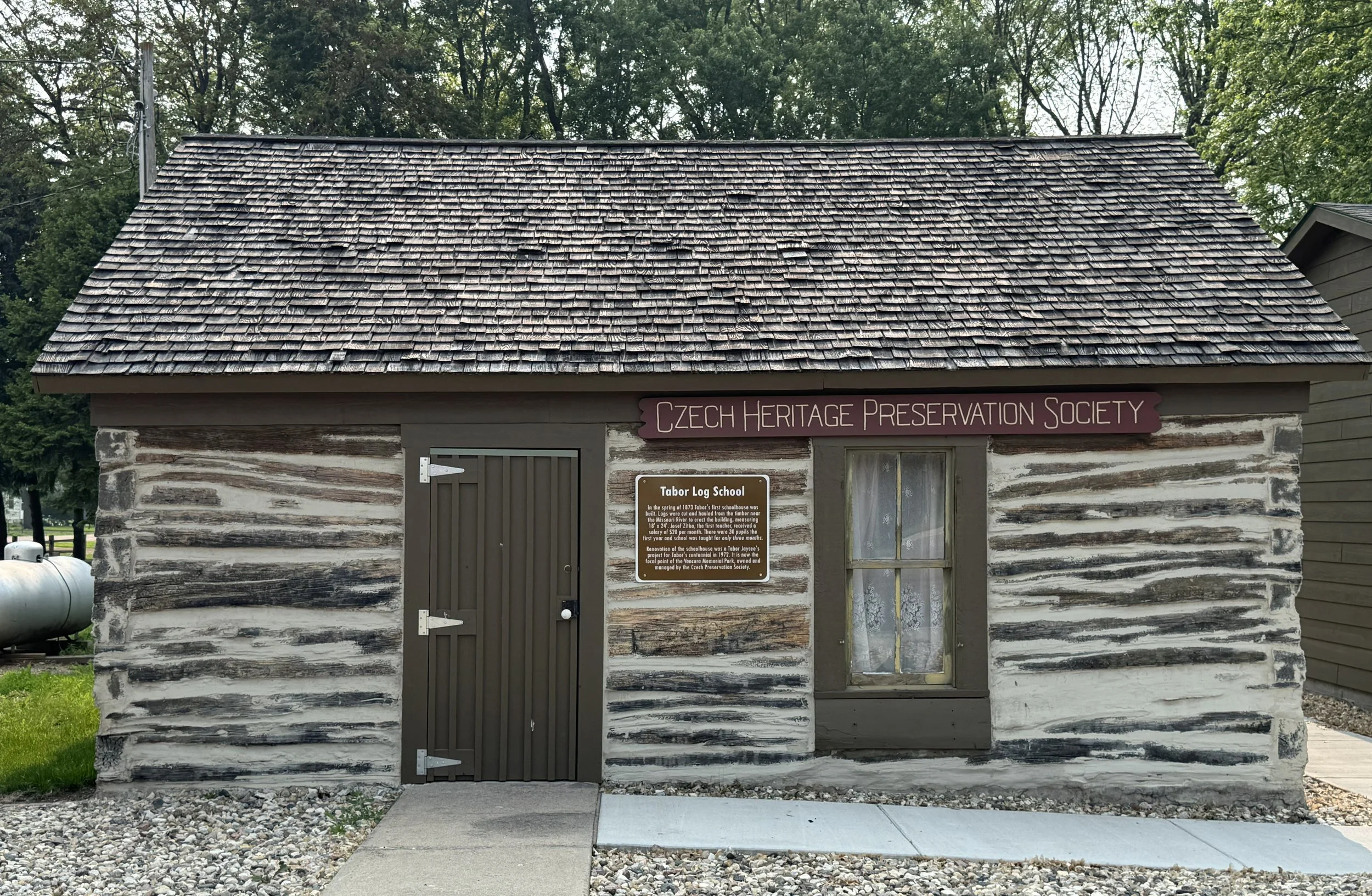
Dad and I set out due west, into Nebraska, through miles of farmland covering low hills. We then turned northwest, parallel to the Missouri River, before crossing it at the town of Vermillion. A short while later, we arrived in Tabor, where my grandmother’s (Dad’s mom’s) Czech family first settled in America. The town was established in 1869 by Czech immigrants who were looking to avoid military conscription in the Austro-Hungarian Empire. Each year, Tabor holds a Czech Days festival — we missed it by just two weeks — that has run for 76 consecutive years, drawing up to 10,000 visitors to this little town of about 400.
We cruised another block further to see Saint Wenceslaus Catholic Church, which my grandmother’s family would have attended after its construction in 1898.
I took a walk through the cemetery, filled with Czech surnames, while a blackbird nearby squawked at me ceaselessly. I recalled being attacked by a red-winged blackbird during our trip through Beloit, Wisconsin, a year earlier, when I flapped and hopped and shouted like a fool in a public place. I took my remaining cemetery photos with haste.
We drove a little further to Leonard Cimpl Park, home of the amateur Tabor Bluebirds of the South Central League. The place looked like it had been given a recent re-paint, and the field appeared well-tended.
Lesterville, South Dakota
We drove a few minutes further to Lesterville, where Mabel Mae Freidel — Dad’s mom, and truly the finest person I have ever known — was born on February 24, 1915. Lesterville is named for an early postmaster named Lester Dix and is even smaller than Tabor, with about 115 residents and very little sign of life on what might be considered its main street.
But they play ball in Lesterville — in a two-ballpark complex at the end of the primary residential street. The Lesterville Broncs are the town’s entry in the South Central League.
World’s Only Corn Palace
When we created our itinerary, I was happy to see we would have a chance to stop by the “World’s Only Corn Palace” in Mitchell, South Dakota — a Moorish revival building covered in murals and decorations made from corn and other grains.
Mitchell’s first corn palace was built in 1892 for the Corn Belt Exposition, meant to lure new settlers to fertile South Dakota. It was rebuilt in 1905 and again in 1921 — a structure that lasts to this day, with domes and minarets added in 1937. Each year, the palace exterior is redecorated anew using hundreds of thousands of ears of corn, plus grasses and grains.
The theme for 2025 was “Wonders of the World” and featured the Taj Mahal, Sydney Opera House, Statue of Liberty, the Roman Colosseum, Brazil’s Christ the Redeemer, the pyramids of Egypt, the Grand Canyon, and more. Local artists worked with students from Dakota Wesleyan University to design the murals and help bring the corn to the canvas.
As I finished taking my photos, I consulted the map to see how much time it would take to reach Pierre, the capital of South Dakota, and the site of our game that afternoon. I realized that I had somehow miscalculated the drive by a full hour, giving us no chance to arrive when the ballpark gates opened. We jumped back into the car and sped away.
Fortunately, our path to Pierre began on Interstate 90, a stretch of road with a speed limit of 80 miles per hour. I pushed a little past that to help make up time. Our goal had been to see a bit of Pierre before the game, but now we just needed to get there and figure out the rest later.
We turned off on Highway 83 and went north for another 35 miles to a little ballpark at the center of the state capital.