St. Paul to Mankato
Dad and I spend the morning touring the sights around downtown St. Paul before hitting the road for Mankato, Minnesota.
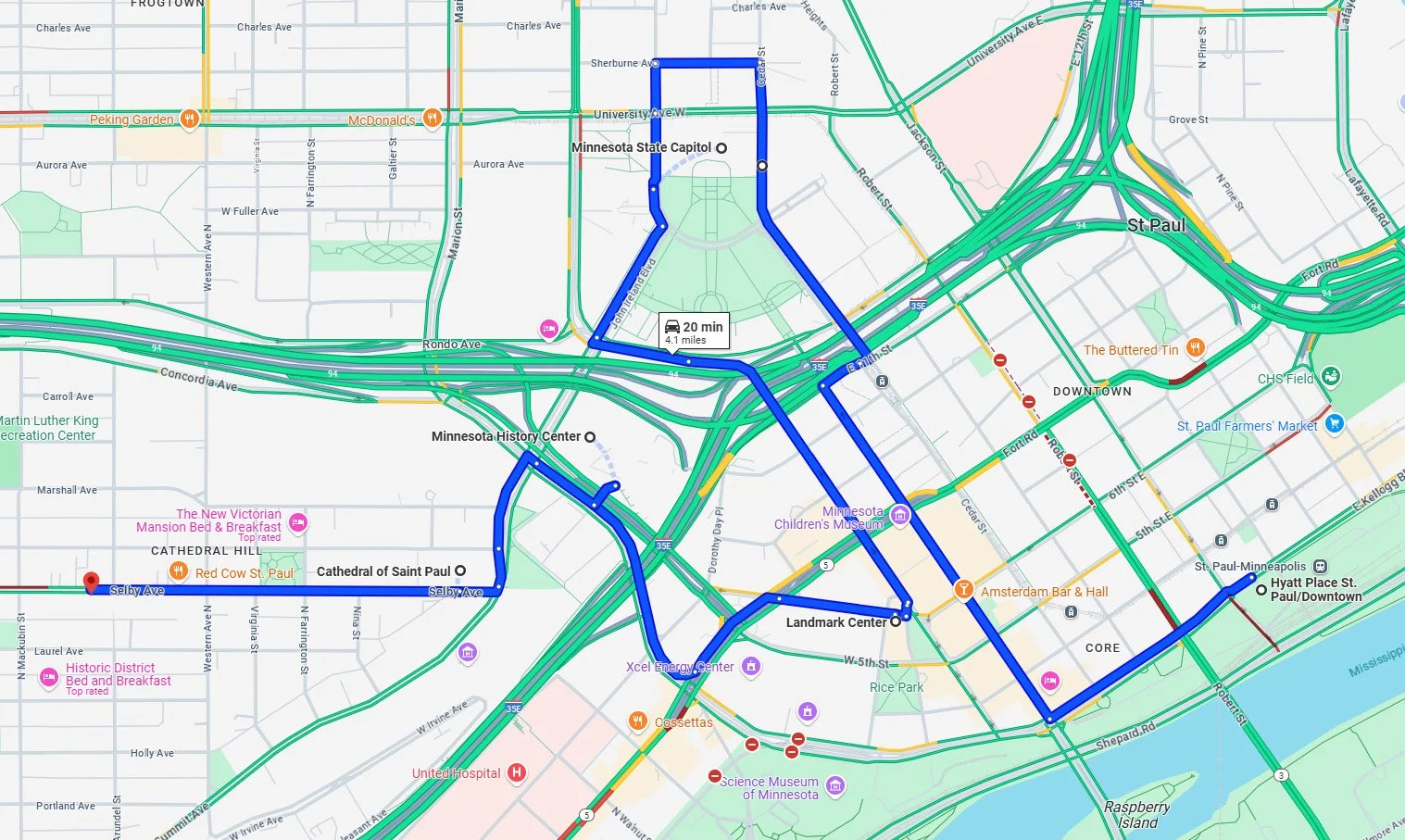
Fresh off our ballgame with the St. Paul Saints, Dad and I began our morning by seeing sights around downtown St. Paul, Minnesota’s second-most populous city.
Burial mounds along the Mississippi River suggest the area was inhabited by Hopewell Native Americans about 2,000 years ago. In 1819, the United States built Fort Snelling at the confluence of the Mississippi and Minnesota rivers, then signed a treaty with the local Sioux in 1837 to acquire all lands east of the Mississippi.
St. Paul was initially known as "Pig's Eye Landing" after Pierre "Pig's Eye" Parrant, a fur trader, tavern owner, and bootlegger who set up operations there in 1838. Three years later, a log chapel was built on a bluff above the Mississippi and named for Saint Paul the Apostle. Locals quickly adopted the name for their fledgling settlement.
Minnesota State Capitol
St. Paul was incorporated in 1854, and four years later, it was made the capital of the new state of Minnesota. The original Capitol building was destroyed by fire in 1881. Its replacement was soon found to be too small, not fireproof, and susceptible to dry rot.
The current and third Capitol was completed in 1905 in an architectural style that blends Beaux-Arts with American Renaissance, inspired by buildings constructed for the 1893 Chicago World’s Fair. It is fronted by a statue of native son Hubert Humphrey, who was vice president of the United States from 1965 to 1969.
Minnesota History Museum
Our next stop was the Minnesota History Museum. Although the vibe of the museum was aimed a little younger than we would like — and indeed, groups of schoolkids bounced and hooted their way through the place while we were there — it is still a quality recounting of the state’s history — its forests and lakes, inventions and industries, indigenous peoples, cultural icons, and notorious weather.
Sports is of course a big part of that history. The museum paid particular homage to the Rondo neighborhood, a center of Black culture in St. Paul — with Black-run businesses, churches, sports teams, music venues, and more — along the length of Rondo Avenue. The Negro league St. Paul Gophers played there, and other neighborhood parks hosted additional teams. Hall-of-Famer Dave Winfield — the first sports star I ever saw in person when he patrolled the outfield for the San Diego Padres — learned to play baseball in Rondo.
Sadly, Rondo’s cultural cohesion was bulldozed in the 1950s and 1960s to make way for Interstate 94, which ran right down the center of the neighborhood. Roughly 700 homes and 300 businesses were destroyed in the process.
Landmark Center
We made a brief stop at Landmark Plaza to admire the Landmark Center building, which was completed in 1902 to help establish the presence of the federal government in Minnesota. It originally housed the U.S. Post Office, Federal Courthouse, and Customs House for Minnesota and the Upper Midwest. It now hosts art and history exhibits.
St. Paul’s Cathedral
We continued to St. Paul’s Cathedral, a significant upgrade to the original 1841 log chapel named for the same apostle. It was the brainchild of Archbishop John Ireland, the most influential Catholic leader in Minnesota’s history, who wanted to build a national Catholic landmark as a statement of permanence for European immigrants who shared the faith.
Completed in 1915, the Beaux-Arts cathedral features elements of Classical Renaissance architecture and was inspired by French Catholic churches as well as St. Peter’s Basilica in Rome. Its massive copper-clad dome is one of the largest unsupported domes in the world.
Inside, the cathedral feels light and open, with 24 chapels and alcoves dedicated to saints important to immigrant communities. A huge organ from the Aeolian-Skinner Organ Company of Boston presides over the cathedral’s front entrance.
Lunch at La Grolla
We drove through the pleasant Cathedral Hill neighborhood just behind St. Paul and landed at La Grolla, a cozy Italian spot for lunch. I tried the Italian Prosciutto Sandwich with roasted red peppers, pesto, goat cheese, and arugula. Dad had the Roquefort e Pete salad with chicken, pears, grapes, and spiced pecans. Both were very good.
Candy Heaven
After lunch, we set out for Mankato, Minnesota, the site of our next game with the Mankato MoonDogs. As the city gave way to rural roads and farmland, I looked ahead at our route along Highway 169 and noticed “Minnesota’s Largest Candy Store” on the map. It seemed an unscheduled stop was in order.
Located in Jordan, Minnesota, Minnesota’s Largest Candy Store is officially known as Jim’s Apple Farm, but it is so much more than a shop for candy or apples. Painted bright yellow to encourage detours like ours, the roadside complex of buildings also boasts the world’s largest selection of sodas, plus fresh-baked pies and strudels, jams, jellies, meats, cheeses, pastas, pickles, and a wide assortment of puzzles.
The operation began as a simple apple farm, sold to the Wagner family in 1900. In the 1960s, Herbert R. "Hippy" Wagner added old-fashioned candies like salt-water taffy to his roadside wares; his sales boomed. Soon, the candy business outstripped the apple business, and Wagner leaned into the shift with vigor.
The interior of the sprawling store is painted and decorated with scenes and characters from well-known fairy tales and animated movies in bright colors and exceptional detail, enhancing the feeling of wonder as customers gawk at rows and rows of sweet splendor.
Mankato, Minnesota
Less than an hour later, we arrived in Mankato, a town of about 45,000 people situated at the confluence of the Minnesota and Blue Earth rivers. It was first settled by Europeans in 1852 and incorporated as a city just six years later, on the same day Minnesota became a state.
Mankato is home to Minnesota State University, the state’s second-largest university, which served as the Minnesota Vikings training camp for 52 years.
Mankato was also the site of the largest mass execution in U.S. history following the Dakota War of 1862, when tribes known collectively as the Santee Sioux — facing starvation and displacement — attacked white settlers along the Minnesota River, killing hundreds. The state and federal governments responded swiftly, hanging 38 men for their involvement in the uprising, confiscating all remaining Sioux land in the state, and forcibly moving the indigenous population to reservations in Nebraska.
Dad and I paused at several spots in Mankato to admire sculptures and monuments scattered throughout the town — including one in Reconciliation Park depicting a scroll with the names of the 38 men executed in the Dakota War.
We finished our tour at the Blue Earth County Courthouse, built in 1889. It replaced a much smaller building that commissioners said gave the impression that “the county was either poverty stricken or greatly lacking in enterprise.”
Our own enterprise had been well-rewarded during another busy day on the road. Our journey had passed the halfway point, but we still had plenty of ballgames and sightseeing in front of us. Dad and I headed to our hotel to rest up for Game 11 of 20.