
St. Paul Saints
Ushertainers! A bonanza of ballpark food! A ball pig! It’s a big night of Triple-A baseball as Dad and I see the St. Paul Saints at CHS Field.
Dad and I rested before the game in a downtown hotel with curiously tall ceilings, then traveled a few blocks to CHS Field, home of the St. Paul Saints, the Triple-A affiliate of the Minnesota Twins. We parked across the street at the Farmer’s Market, passing a six-piece band playing “Too Late for Goodbyes” by Julian Lennon.
CHS Field opened in the Lowertown District of St. Paul in 2015 for an estimated cost of $64.7 million. Its design includes a 300-panel solar array that helps power the ballpark and the scoreboard, and a rainwater harvesting system that accounts for about 10 percent of flushes at the ballpark.
CHS Field can accommodate 7,210 fans; the Saints tallied 5,681 per game in 2025, which was middle of the pack in the International League.
The story of the St. Paul Saints begins in 1884 with the Sioux City Cornhuskers, who played in the Western League for a decade before Charles Comiskey bought the team and moved them to St. Paul as the Saints. In 1899, the Western League renamed itself the American League — still a minor league and subordinate to the National League. In 1900, Comiskey moved the Saints to Chicago, renaming them the White Stockings — part of a plan with American League Commissioner Ban Johnson and Pittsburgh Pirates manager Connie Mack to elevate the league to major league status, which it achieved in 1901.
That same year, a new St. Paul Saints team emerged in the minor league American Association. Over the next 60 years, the franchise won nine titles and the 1924 Little World Series against the Baltimore Orioles of the International League. The Saints served as a farm club for the White Sox (1936-1942), Brooklyn Dodgers (1944-1957), and Los Angeles Dodgers (1958-1960). In 1948, Roy Campanella became the first person to break the color barrier in the American Association as a member of the Saints.
When the Washington Senators moved to Minneapolis to become the Twins in 1961, the Saints moved away from the Twin Cities to Omaha, Nebraska, as the Omaha Dodgers.
The current Saints franchise began in 1993 in the independent Northern League. However, the Saints and three other clubs — the Lincoln Saltdogs, Sioux City Explorers, and the Sioux Falls Canaries — left the Northern League in 2005 to form the independent American Association of Professional Baseball. The Saints were co-owned by comedian Bill Murray and Mike Veeck — son of marketing mastermind Bill Veeck — and together they built a reputation for over-the-top ballpark promotions. Diamond Baseball Holdings now owns the club (and more than 40 others), but the Saints retain a mystique for inventive fun.
Alumni from this franchise include Darryl Strawberry, Rey Ordóñez, Kevin Millar, Jack Morris, Glenn Davis, J. D. Drew, and Leon "Bull" Durham. At the age of 69, Hall-of-Famer Minnie Miñoso was invited to come out of retirement for an official at-bat as a Saint. He failed to reach base, but St. Paul brought The Cuban Comet back a decade later, and he worked a walk.
The Saints team store is just inside the front gate, visible from the street. It was stuffed with fabulous merch, and I mean that both as praise and critique: It’s a lot smaller than most Triple-A team stores.
The Saints main script is a modernization of the style worn by the old minor league Saints squad. Other alternate lockups feel equally classy and true to baseball.
In 2025, the Saints unveiled a new identity: the Crooks Haven Ghostly Gangsters. During Prohibition, St. Paul was considered a haven for crooks of all sorts — gangsters, robbers, bootleggers — who came to St. Paul to hide from the FBI. Outlaws like John Dillinger, Babyface Nelson, Roger "the Terrible" Touhy, Machine Gun Kelly, Alvin "Creepy" Karpis, and the Barker gang found refuge in places like the Washaba Street Caves, carved into the sandstone under St. Paul.
I walked down the third-base line to check out the City of Baseball Museum, an excellent mini-museum filled with memorabilia and displays telling the tale of baseball in St. Paul.
That story begins with Sandlot ball, most prominently represented by the Olympic Club, which played organized baseball as early as 1858. They took on the Red Caps, Blue Caps, the Saxon club, and others, beginning a long tradition of amateur baseball that continues to this day with Townball.
The museum’s displays also cover the St. Paul Colored Gophers, a barnstorming club formed in 1907 that was Minnesota’s first all-black baseball team; Toni Stone, who played for the Twin City Colored Giants at age 16 and in 1953 became the first woman to appear in a men’s professional baseball league when she played second base for the Negro league Indianapolis Clowns; and of the heated rivalry between the Saints and their Twin Cities rival, the Minneapolis Millers.
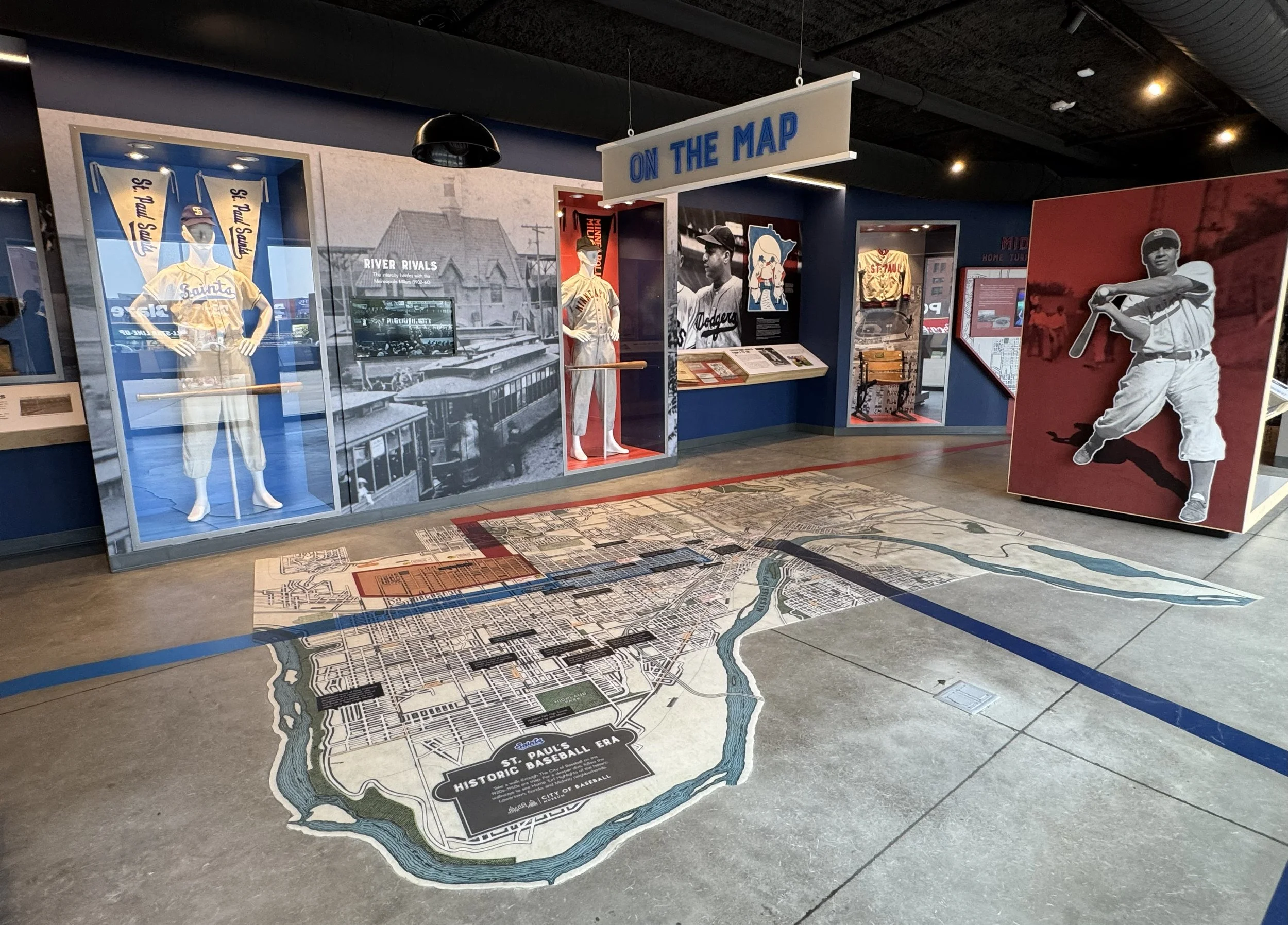
The museum concludes with the modern St. Paul Saints, who brought serious fun to independent baseball and completed a comeback to the minor leagues.
After the museum, I walked down the right-field line to meet friends coming to the game who had moved from the Bay Area to Minneapolis. On the outfield grass, groups of kids played a quick game of chaotic Wiffle ball. The concourse felt pretty lively, but the anachronistic Treasure Island Terrace (named for a nearby casino) apparently had not been booked for the evening.
Saints PA announcer Lee Adams began his pre-game work sitting just outside the backstop netting.
In that same area, I found Saints batboy Mac Grady, who had followed the planning for our road trip. He said hi, tossed me a ball, and got back to work. I also got my first look at one of the Saints Ushertainers, Chef, who was apparently looking up a recipe on his phone — and scrolling down, down, down, past the origins of the dish… ads… ads… past the cultural relevance of its ingredients… ads… ads… past the multi-stage explanation of a dead-simple cooking technique… ads… ads…
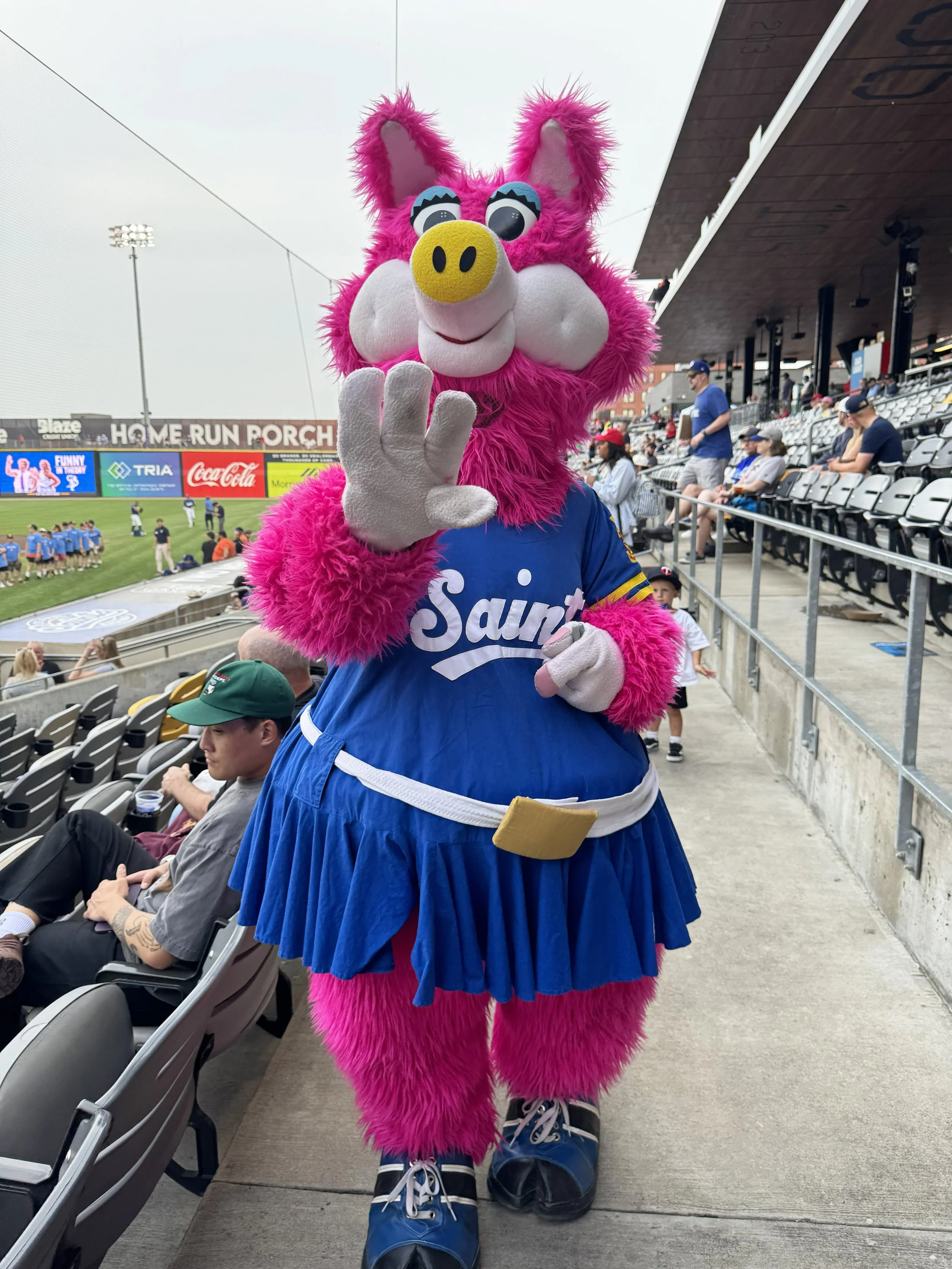
Just behind me, Mudonna strolled by. The Saints mascot was first introduced in 2003 and is described by the team as “the divine swine, the diva of the diamond, the duchess of pork.” In 2024, she hugged 90 people in 60 seconds, breaking the previous record of 89 set by a red M&M in Shanghai, China, which in turn broke the record of 85 set by Virginia Tech's HokieBird. Apparently, the key to efficient hugging is wearing a bulky mascot costume.
Dad and I also got a chance to chat with Michael Speltz — a minor league baseball fan and deep weather-data aficionado — who had followed our journeys for years on social media.
After 55 games in the 2025 season, the St. Paul Saints were just a game above .500, sitting in sixth place in the International League’s West division. They wore their sharp blue home jerseys for the occasion.
They were hosting the Scranton/Wilkes-Barre RailRiders, a Yankees affiliate who were in seventh in the East. Their performance would pick up in the second half of the season, when they would go 49-26 and reach the International League championship series, losing to the Jacksonville Jumbo Shrimp two games to one.
An important part of the pre-game ceremonies at CHS Field is the introduction of the Ball Pig, who hoofs out to home plate to give umpires fresh baseballs. This ball pig’s name was the Great Fatsby, the latest in a long line of St. Paul porkers.
Previous ball pigs were given similar porcine-pun monikers: Little Red Porkette, OzemPig, 867-530Swine, Notorious P.I.G., Ham Solo, Kevin Bacon, and SlumHog Millionaire. A few of them are honored for their on-field achievements in a display at the back of the concourse.
Lineups were traded, the anthem was sung, and we were underway.
Randy Dobnak
The RailRiders jumped on the ball early, collecting two hits and a sacrifice fly to score a run off St. Paul starter Randy Dobnak. The 30-year-old, bushy-bearded right-hander had played 39 games over five seasons for the big-league Twins, beginning with a meteoric 2019 season in which Dobnak started with the High-A Fort Myers Miracle and finished pitching at Target Field in Minneapolis, where he compiled a stellar 1.59 ERA in 28 1/3 innings. That led to a five-year, $9.25 million contract with the Twins after the shortened 2020 season.
But Dobnak struggled in 2021, then ruptured ligaments in his right middle finger — a digit crucial to the success of his sinker — that sidelined him much of the 2021 and 2022 seasons. He had made one start for the Twins in the first week of the 2025 season, giving up just one earned run into the sixth inning. Nonetheless, Dobnak was sent down to St. Paul and would not be back. He would be traded to the Detroit Tigers later in the summer and would be kept at the Triple-A level with the Toledo Mud Hens.
The RailRiders countered with right-hander Anthony DeSclafani, who had made it to the majors with four different teams for parts of nine seasons. He gave up his first run to the Saints in the second, then struggled through the third and allowed three more.
The Saints motto is “fun is good,” and there was plenty of fun to be had on this night (deep inhale): a tire race around the infield; a giant eyeball race; a styrofoam airplane toss-and-catch from the right-field wall; a rolled-up newspaper catch from the same spot; kids racing in tiny trucks; a chipping challenge; a snow-angel contest; a milking competition from a Holstein bucket; a produce toss into a shopping art; an inflated sumo recycling relay; and inflated dinosaurs doing calisthenics. And damn, Dad really laughed at those dinosaurs.
Not bad for a Wednesday night! (Watch the episode!)
Dobnak regained some control over the Scranton/Wilkes-Barre lineup, holding the visitors scoreless over his next three innings. The Saints led it 4-1 after four.
Perhaps the greatest joy of a Triple-A ballpark is the sheer number of dependable and interesting choices for dinner. We both love a good brat, but during a 20-ballpark road trip, variety is welcome. CHS Field had Mexican food, cheesesteaks, gyros, Chinese food, and more.
I had the Footlong Brisket Hot Dog, topped with brisket hash, pepper gravy, and cheddar cheese. It was good, but the bun was just waaaaaay too much bread. I paired it with a Furious IPA from Surly Brewing, which I had first tried earlier in the day at The Lowry.
Dad had the fish and chips which he deemed “excellent.”
Scranton/Wilkes-Barre scored a run in the top of the fifth to close the gap to 4-2. In the top of the sixth, the RailRiders rattled off a couple of singles and shortstop Brandon Shewmake hit one of his four home runs of the season, giving his team a 5-4 lead.
The Saints put together a walk, a stolen base, and a double to tie it in the bottom half.
During the bottom of the fifth, a foul ball rattled off the mask of home plate umpire Raul Moreno, who fell backward to the ground, took of his mask and helmet, and laid his head back. He remained still for several minutes, communicating with Saints staff at his side. Eventually, Moreno sat up to a round of applause, but then remained sitting for a few more minutes. He then made it to his feet, but stood in one spot for another minute or so before being escorted off the field. One of the two umpires working the bases changed gear to take home plate, and after a 10 to 15-minute delay, play resumed.
After the seventh-inning stretch, I took one final circuit of CHS Field. Dessert vendors that had done a brisk business were getting ready to close up shop.
The seventh inning passed as quietly as the setting sun to the west.
Kids in the outfield play area took their last climb and tossed their last balls as patient parents presided.
It was also last call at the drink rails above the left-field wall.
Both bullpens kept warm as landlubbers lounging on the Treasure Island Berm stayed focused on the tie ballgame.
The RailRiders put a runner on second base in the eighth but did not score.
Then things went dumb for Scranton/Wilkes-Barre in the bottom of the eighth. A single, a walk, and an error off RailRiders reliever Colten Brewer loaded the bases for the Saints. Brewer then walked designated hitter Edouard Julien to bring home the go-ahead run. Brewer was replaced by reliever Leonardo Pestana, who walked the fiirst hitter he faced to make the score 7-5 St. Paul.
As we watched the last inning unfold, Ushertainers Nerd and Nerdette stumbled by, followed by Chef and Seigo Masubuchi, famous for his karaoke skills and his long-distance running. A week after our visit to CHS Field, Masubuchi ran a full Marathon around the concourse during a Saints game.
Left-handed closer Richard Lovelady shut the door for St. Paul in the ninth, and the home team came away with the 7-5 victory — three hours and 19 minutes after the first pitch. We bid a hasty retreat. It had been a long day and a longer night, and we were just halfway through the road trip.