
Omaha Storm Chasers
It’s Runza Night at Werner Park in Papillion, Nebraska, where Dad and I see the Triple-A Omaha Storm Chasers host the Iowa Cubs.
We’ve learned a lot from our five years of doing big regional ballpark road trips — about balancing sights with rest, about looking for suite rooms and walk-in showers at the hotels, about how best to spend our limited time at each ballpark through routines that maximize our time together.
And we have learned that if you show up at a good Triple-A ballpark on a Saturday night, it’s going to be a big time.
We arrived more than 90 minutes before gametime at Werner Park in Papillion, Nebraska — home of the Omaha Storm Chasers — and a healthy line had already formed at the gates. Because it was not just Saturday night at a Triple-A ballpark — it was Runza Night in Omaha. Much more on that later.
Werner Park is located just southwest of Omaha in the city of Papillion, Nebraska, a suburban community full of gently rolling hills and suburban housing. The ballpark was built in 2011 for about $36 million. It can accommodate more than 9,000 fans, with 6,200-plus fixed seats, more than a dozen private suites, and grass-berm seating. The Chasers averaged 3,720 fans per game in 2025, 17th-best in the International League.
Bob Gibson, Omaha Cardinals, 1957-1959
Professional baseball was played in Omaha as early as 1879, if only for a half-season. In 1885, a team called the Omahogs… wait, wait, wait. Hold on. Let’s just take in — for a moment of simple joy — the fact that a baseball team in Nebraska’s largest city played as the Omahogs.
In 1900, Omaha joined the nascent Western League and appeared as the Indians, Rangers, and Rourkes — named after owner-manager William “Pa” Rourke. But in 1936, the club’s Vinton Street Ballpark burned down, and pro baseball left Omaha for more than a decade.
The Class-A Omaha Cardinals of the Western League flew into town in 1947 and two years later moved into Johnny Rosenblatt Stadium — future home of the College World Series. The team moved to the Triple-A American Association in 1955, replacing the Columbus Red Birds as a St. Louis Cardinals affiliate. Cardinals Hall of Famer and Omaha native Bob Gibson made his pitching debut with the Omaha Cardinals in 1957, finishing out that year by touring with the Harlem Globetrotters before committing his future to baseball.
The American Association contracted in 1959, and the Omaha Cardinals were left out. The Los Angeles Dodgers set up a Triple-A Team in Omaha in 1961, but it lasted just two seasons.
Despite this early turmoil, Omaha’s current minor league franchise is one of the steadiest in the game. It began with the Omaha Royals.
The Royals came to life in the same 1969 season as their parent club, the Kansas City Royals, and the two have been affiliated ever since — by far the longest of any such partnership in Triple-A. Omaha entered the circuit with a bang, winning back-to-back titles in its first two seasons under Manager Jack McKeon. (The Royals skipper went on to architect one of the two Padres teams to reach the World Series in 1984, giving him and his trademark stogie a place in my heart.)
In 1999, the team changed its name to the Omaha Golden Spikes in a commendable effort to move away from parent-club branding. But it did not take, and the Royals returned in 2002.
When it was time to leave the aging and oversized Rosenblatt Stadium for Werner Park in 2011, the franchise tried another rebrand — a clean break in a brand new ballpark built for the team. This time, it worked. Omaha has embraced the Storm Chasers. It didn’t hurt that the club won the Pacific Coast League championship in the inaugural 2011 season using the new moniker, or that it won the title again in 2013 and 2014 — an incredible run for a league with so much turnover.
Omaha has since moved to the International League, which expanded to 20 teams in 2021. They were the league’s defending champs when we arrived at Werner Park.
If you know the names of major league players who started with the Kansas City Royals — George Brett, Frank White, Clint Hurdle, Eric Hosmer, Mike Moustakas, Bobby Witt Jr., etc. — you can be assured they came through Omaha.
Dad and I made a visit to the Storm Front Team Store, an opulent emporium of Storm Chasers goodness befitting a Triple-A ballclub.
The fine merchandise on display prominently included hats and jerseys to be worn on this Runza Night.
We both went with the primary Storm Chasers logo, mine on the all-blue home hat. With so many good options but only one allowable purchase — according to my personal set of checks and balances — my selection felt a bit conventional, if an anthropomorphic tornado with balled-up fists and a bat barrel for a nose can be considered conventional.
Runza Night celebrates the runza sandwich, a casual-food obsession in Nebraska. It’s fresh-baked bread stuffed with ground beef, onions, cabbage, and a secret blend of spices. First introduced in 1949 in Lincoln, Nebraska, by German immigrants, there are now more than 90 Runza locations in the Midwest, 85 of them in the Cornhusker State.
To celebrate this critical cultural institution, fans received giveaway Runza Hawaiian shirts. Just look at this beauty!
The shirt, I mean.
The Storm Chasers aka Runzas had struggled in 2025, winning just 25 of their first 60 games. Omaha would finish the season with a 31-43 record in both halves of the season, placing them near the bottom of the International League’s West division.
The Cubs came in a few games above .500 and would remain there for the first half, dipping below .500 for the second half. Neither team would make the playoffs in the demanding International League.
Earlier in the day, I had reached out to Storm Chasers President and General Manager Martie Cordaro — who was aware of our road trip via social media — hoping to connect at the ballpark. He invited me to see him at the very popular Downdraught bar in left field, where he was playing drums with his band before the game. When I think of team executives, I think of suits and slacks, maybe a more casual polo shirt on gameday — not a guy in a rock-and-roll t-shirt and shorts laying down the rhythm for “Low Rider.” It was cool to see Martie in his element.
Rich Hill
Our excitement for this Storm Chasers game extended beyond the big crowd, the excellent ballpark, and the Runza-based promotional festivities. There was real drama on the diamond as 45-year-old Rich Hill took the mound for Omaha. Hill first played professional ball in 2002, before some of his Storm Chasers teammates were born. In his 24-year career, Hill had pitched for 13 Major League teams over 20 seasons and was now trying to make his way onto his 14th big-league roster with the Royals.
Hill dismissed the top of the Cubs lineup with a 1-2-3 inning in the first. He worked with an intensity required to stay competitive for more than two decades, cursing loudly whenever one of his pitches did not hit his intended target.
Hill’s opposite number for the Cubs was 6-foot-4 right-hander Peter Soloman, who had appeared in 11 major league games but had not reached The Show since 2023. He gave up two singles, a walk, a steal, and a wild pitch in the first, and the home team led it 2-0.
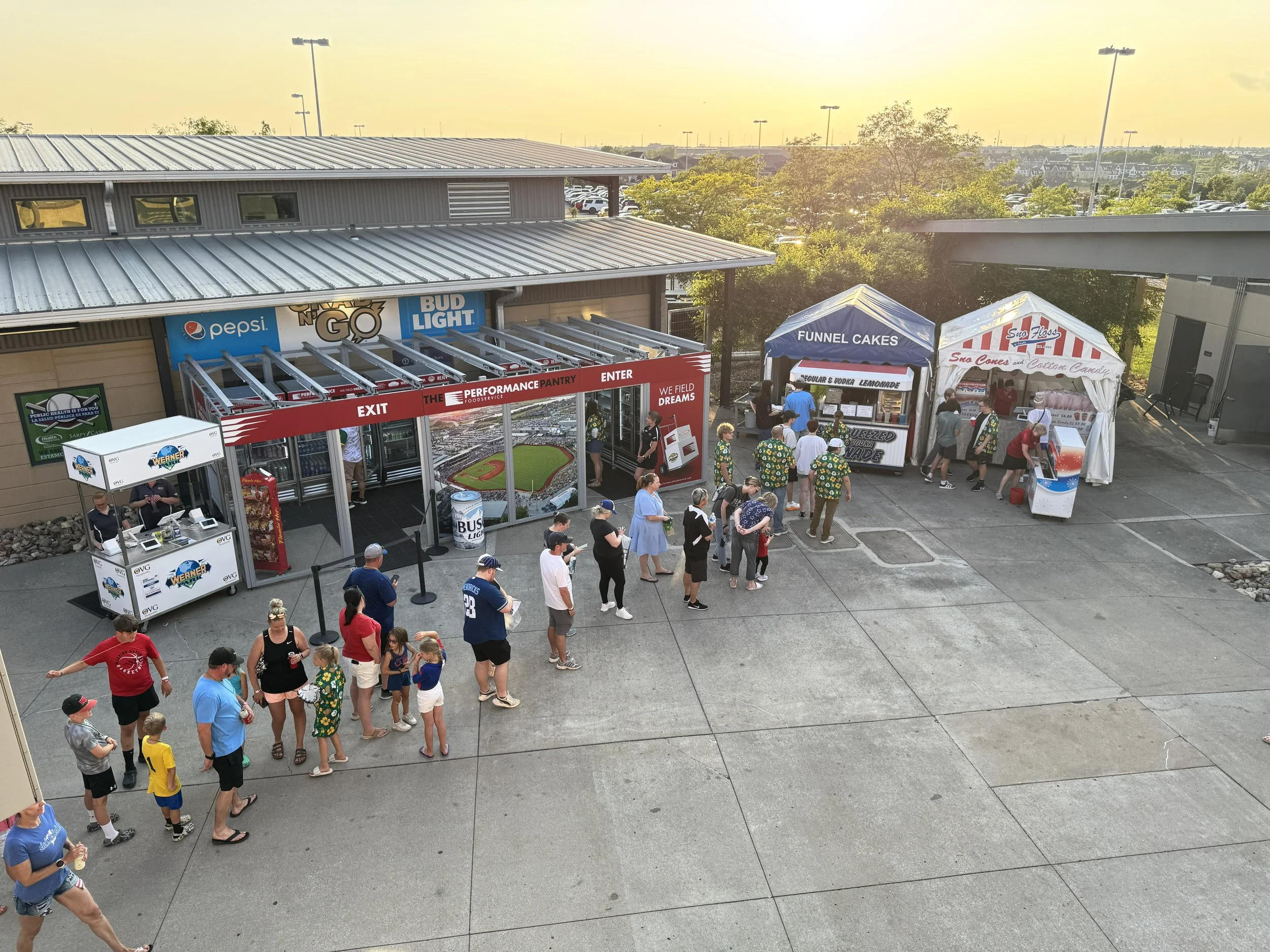
I made my tour of the concession stands to see what they had to offer — sausages, cheesesteak, barbecue, pizza, and more — but our dinner decisions had been made for Runza Night.
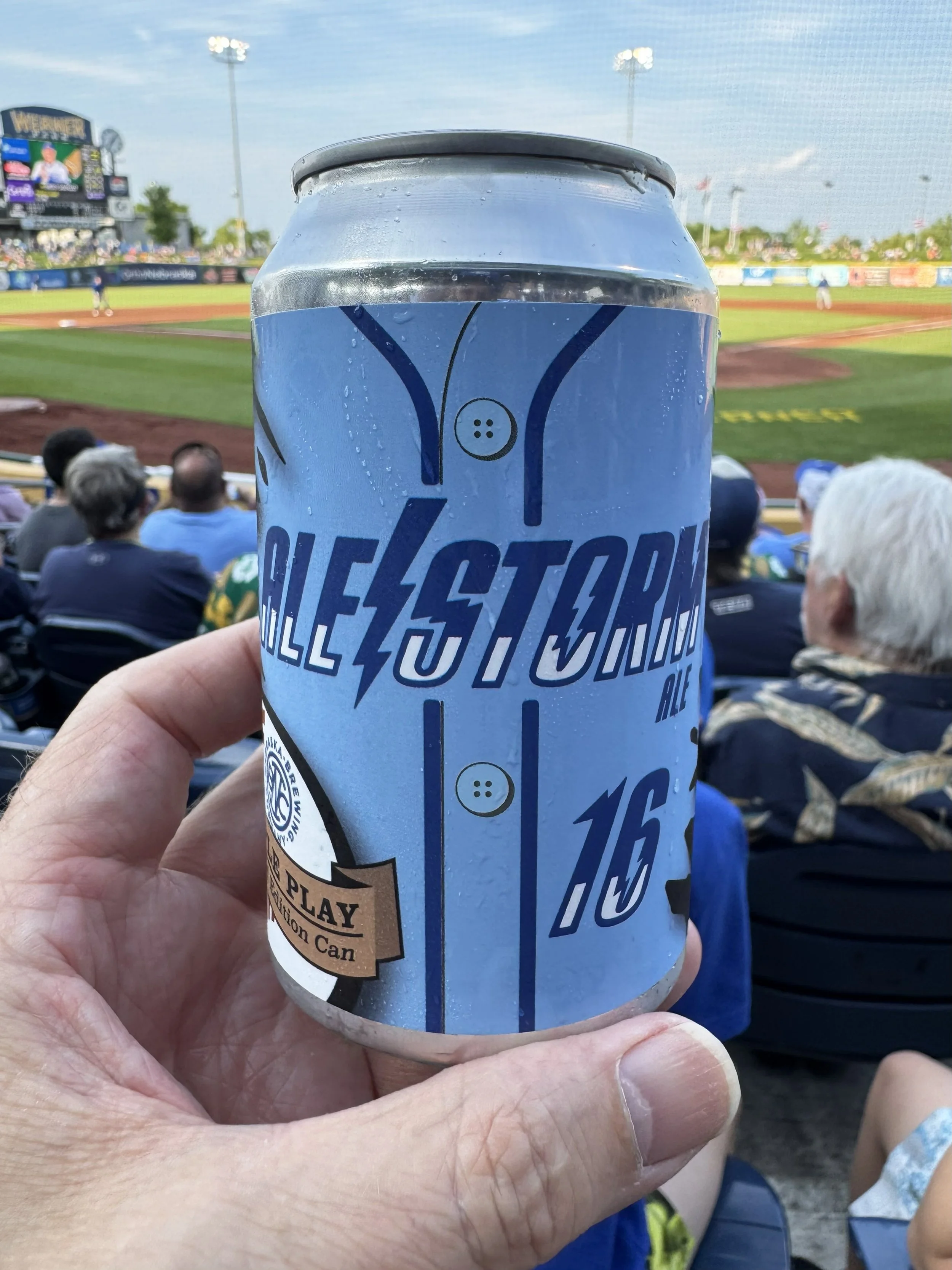
The line for Runza sandwiches was long but moved quickly. I brought two back to our seats and handed one to Dad for our taste test. We both liked the handy packaging and the unique flavor of our Runzas, but thought they would benefit from a little more meat. I paired mine with an Ale Storm Ale, made for the team by Nebraska Brewing Company.
Martie reached out to me during the game and invited me to sit with him, his wife Sara, and their friends. Relaxed and friendly on a beautiful Saturday evening at the ballpark, Martie talked about the challenges of leading both the Storm Chasers and Union Omaha, a professional soccer team playing in League One of the United Soccer League. Cardaro came to Omaha in 2008, serving as assistant general manager for one season before being promoted to general manager. He led the rebranding of the Storm Chasers in 2011, then added Union Omaha to his duties when that club was founded in 2019 — all while managing the day-to-day operations of Werner Park.
As we chatted, Hill unleashed another expletive that could be heard easily from our seats about 15 rows from the field.
Martie led me up to the broadcast booth, where I got to watch the “Voice of the Chasers,” Nicholas Badders, call the game before introducing myself between innings. Like the players on the field, Badders had worked his way through the ranks in broadcasting, doing play-by-play for the independent Sonoma Stompers, the Elizabethton Twins of the collegiate Appalachian League, and the Melbourne Aces of the Australian Baseball League. Badders had most recently served as the broadcaster for the Double-A Northwest Arkansas Naturals before being called up to Triple-A.
Martie left the booth to attend to fans in one of the suites, and I set out down the left-field line for some additional views of Werner Park.
Hill left the game after six innings of outstanding work, giving up just one unearned run on one hit, with two walks and six strikeouts. He would get a call-up to Kansas City later in the season but would struggle in two appearances, allowing five earned runs in nine innings.
Soloman lasted just 3 1/3 innings. The Storm Chasers plated two in the second and added runs in the third and fourth to make it 6-1 Omaha after six.
With so much going on, I couldn’t catch everything happening between innings, but I did manage to see a Runza-wrapping competition, a game with one contestant slingshotting money to a partner to catch in a bucket, the Higher or Lower game, a cushy-ball toss, a snow angel showdown, trivia, and a race between teams in which one contestant retrieved balloons and a teammate provided surfaces (belly, lap, back) to facilitate the forceful popping of each balloon. (Watch the episode!)
Iowa scored two runs in the seventh off lefty reliever Sam Long as I passed by the Family Fun Zone with its vintage carousel, already done turning for the night.
The Cubs were at bat in the eighth when I reached the left-field foul pole and took a few photos of the scene. As I looked through my phone toward home plate, Iowa first baseman Carlos Pérez — who had reached the majors with four different teams — connected on a pitch with a loud whack that could be heard from the bleachers. I looked up to see the ball headed directly towards me. It cleared the wall with ease, bounced on a bench seat, and landed in my hands. A bonus souvenir on an eventful night at the ballpark.
That home run tightened the score to 6-5 Storm Chasers. Both bullpens got to work to close out the game.
I completed my circuit of the concourse with a look at several plaques on the first-base side — in the shape of Royals jerseys — honoring some of the great players and coaches who have come through Omaha on their way to the clubhouse in Kansas City.
Right-hander Andrew Hoffman entered the game in the ninth to preserve the win for Hill and the Storm Chasers. Hoffman would make his first major league appearance with the Royals later in the year before being traded to the Arizona Diamondbacks. On this night, the former University of Illinois hurler recorded two quick outs, then gave up a walk and a single to put the game in doubt. With the tying run on second, Hoffman battled Cubs top prospect, Moisés Ballesteros, to a 2-2 count before slipping a four-seam fastball past him for strike three. Ballesteros challenged the call, but the replay showed that the ball had nicked the bottom of the strike zone, and the Chasers came away with the win.