
College World Series
Dad and I travel across Iowa for the final ballpark of our road trip and the biggest venue of them all — Charles Schwab Field, home of the College World Series.
We woke up to a Big Day. The original itinerary already described a drive across the breadth of Iowa to attend the final game of our 20-ballpark, 21-day, seven-state ballpark odyssey at the College World Series in Omaha, Nebraska.
But new plans were added to the mix when Annie Ochitwa, an associate producer for ABC World News Tonight with David Muir, messaged me to see if Dad and I would help her put together a Father’s Day story on our road trip. The night before, in our hotel room after a rainout with the Burlington Bees, I had gathered far too many video clips and photos and sent them along. Annie said she would email a list of questions the next day and asked us to record our answers.
But where? Where could we find good lighting and a clean background — something evocative of a ballpark, if possible, perhaps with brick walls?
We set out in the morning, heading west on Highway 34 (and avoiding the slightly faster Interstate 80). During the drive, we received Annie’s questions — about the highlights of our journey, about spending time together, and about which region we might see next. We pondered our answers as we continued to Creston, Iowa, and our designated lunch break at Mario’s Sports Bar & Grill.
We both had good taco salads while I worked my phone. I had an idea.
A bank. In the absence of an actual ballpark, a bank would be a perfect backdrop for our video. Nearly every bank has a brick wall to signal its impenetrable safety as a haven for your money. Plus, it was Saturday, so there was a good chance the bank would be closed, and we could film in relative privacy with few passers-by to distract us. I checked my maps app and found Nationwide Bank in downtown Creston, closed on Saturdays, with a spacious parking lot surrounding it. Perfect.
After lunch, we headed there and found exactly what we were looking for: a brick wall, good lighting, and a strip of light shade on this hot June day. We proceeded to answer the six or so questions provided in no fewer than 24 video clips, frequently tripping over our tongues (mostly mine) as we tried to give crisp, interesting answers.
I wanted to get the clips to Annie before we drove on to Omaha. That’s when I realized two things: I had recorded everything in 4K, and we had only a middling cellular connection to the Internet. The 4K quality meant very large files — excluding the numerous bloopers — that had to be downloaded from my gimbal camera to my phone before getting sent over a cellular connection to ABC’s server. I was also concerned about losing our Internet connection along the way and having to start over. So we sat there in the Northwest Bank parking lot for at least 45 minutes, waiting for files to transfer from here to there.
That cost us some time, so I drove rather eagerly from Creston to Omaha. We zoomed up and down the lumpy terrain of western Iowa, reminiscent of the bulbous midwestern landscapes of painter Grant Wood.
We made one final stop, as we always do on these road trips, at a UPS Store just outside of Omaha, so that Dad could ship his 20 baseballs home.
Charles Schwab Field
We arrived in Omaha to find an absolute madhouse surrounding Charles Schwab Field. We had anticipated big crowds for a prestigious event like this, held at a sold-out ballpark that seats nearly 25,000. What we had not considered was that, because we were seeing the second of two games on the day, we were approaching the ballpark with 25,000 fans of LSU and Arkansas, while 25,000 fans of UCLA and Murray State from the first game were leaving the ballpark and filling the surrounding streets.
I had scouted out a nearby parking lot with many handicap spaces, but it was full. I dropped Dad off and drove around for about 20 minutes to a handful of backup lots that were also full. Eventually, I found a space several blocks away and walked past the front entrance of the ballpark on my way to reconnect with Dad.
I met up with Dad, who had spent a little too much time in the sun waiting for me. We walked a little closer to the ballpark and found a golf cart so he could rest and find some respite from the 90-degree heat. Then I crossed the street and entered the Fan Fest, a collection of vendors, food trucks, a music stage, and roughly 6.5 million people. I shuffled through the sweaty throng, snapped some photos, and got out as fast as I could.
I checked in with Dad, then went into the NCAA Authentic Team Store tent to find one last hat and baseball for our final ballpark.
The gates opened, and we joined a packed line of fans clad in purple (for the LSU Tigers) and red (for the Arkansas Razorbacks), the latter punctuating their presence with their trademark “Woo Pig Sooie” chants.
At last, we made it to the concourse and got a look at one of the crown jewels of college baseball.
Charles Schwab Field was built in 2011 for $131 million to replace the venerable yet aging Johnny Rosenblatt Stadium. Its official capacity is 24,505, but a record 28,846 fans attended a College World Series game four days later, and the ballpark was built to expand up to 35,000.
After three weeks of minor league ballparks, this definitely had the feel of a big-time baseball venue.
The first edition of the College World Series was held in 1947 at Hyames Field in Kalamazoo, Michigan, and won by the University of California over Yale. The tournament was played in Kalamazoo again in 1948 before moving to Lawrence Stadium in Wichita, Kansas, in 1949, and finally to Rosenblatt Stadium in 1950, where it remained for more than 60 years.
A lot of talented teams and players have made their mark on the College World Series: Sal Bando hitting .480 while leading Arizona State to the 1965 championship; the six titles won by USC, including five straight, from 1968-1974; Hall-of-Fame slugger Dave Winfield pitching for the University of Minnesota in 1973, giving up just one earned run in 17-plus innings while striking out 29 batters; Terry Francona leading Arizona to a title in 1980; Robin Ventura hitting two grand slams in one inning for Oklahoma State in 1988; Phil Nevin at Pepperdine in 1992; Huston Street playing for Texas in 2002; Adley Rutschman at Oregon State in 2019; and countless more.
LSU has played a huge role in College World Series history, particularly in the modern era. The Tigers came into this opening-round game with seven national titles, all since 1991. LSU had last claimed the crown in 2023, with future Cy Young award-winner Paul Skenes taking the tournament’s Most Outstanding Player trophy.
Perhaps the greatest moment in college baseball history capped LSU’s third title run in 1996. Down by a run with two outs and a runner on in the bottom of the ninth, Tigers second baseman Warren Morris — who was recovering from a recently broken right hand — hit his first and only home run of the season to win it for LSU over the University of Miami. It’s the only time in CWS history that a walk-off home run has decided the national championship.
LSU came into this opening game of the College World Series having just won a super regional tournament on their home field in Baton Rouge, scoring 28 runs in two wins over West Virginia in the final series.
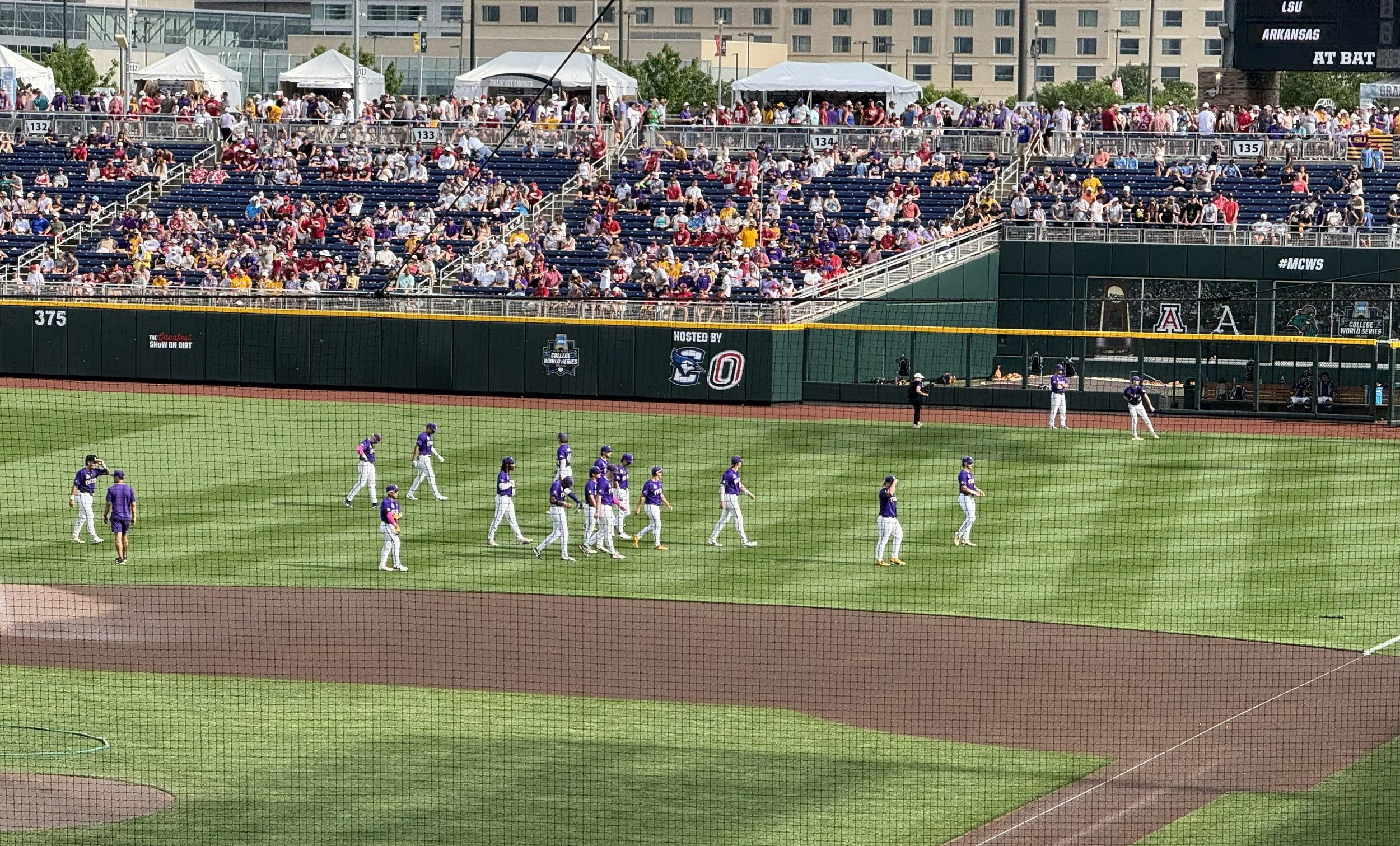
Arkansas had never won a national championship in its previous 11 appearances, dating back to 1979. That luckless record includes one of the most devastating losses in CWS history.
In 2018, the Razorbacks had beaten the Oregon State Beavers in the first game of the best-of-three final series. In Game 2, they led 3-2 with two outs in the bottom of the ninth. Beavers hitter Trevor Larnach — a future first-round pick of the Minnesota Twins — popped a ball down the right-field line in foul territory. Three Razorbacks fielders converged on it for the final out to secure the title. But there was hesitation and miscommunication, and the ball fell to the ground. Larnach eventually worked a walk, and a bloop single tied the game. The Beavers would walk it off in the 11th and shut out the Razorbacks in Game 3 to win it all.
Ranked third in the nation, Arkansas had reason to be optimistic coming into the series. They had swept their super-regional tournament at Baum-Walker Stadium — also their home field — in Fayetteville.
And now here we were, at our 20th and final ballpark in 21 days, taking part in the history still to come. We’d made it, and we were feeling pretty great.
The pre-game ceremonies included an unconventional accordion rendition of the national anthem. ESPN reporter Kris Budden provided some final tidbits for the national broadcast, and we were underway.
Zach Root took the mound for the Razorbacks to start the game. The left-hander from Fort Myers, Florida, would finish the 2025 season with a 9-6 record and a 3.62 ERA, and he would be drafted in the first round by the Los Angeles Dodgers a month later. Root notched a 1-2-3 first inning against the Tigers.
LSU countered with 20-year-old, left-handed phenom Kade Anderson, who came into the matchup with an 11-1 record, finishing the season with a tidy 3.13 ERA. Anderson was known for his exceptional control over four effective pitches. He walked one but also came through with a scoreless first.
LSU jumped ahead in the second, walking, bunting, and singling their way around the bases. Root hit a batter to boot, then left the game with the Tigers leading 3-0.
There were plenty of high-quality ballpark concession stands at Charles Schwab Field. Menu items we passed over included The Mac Attack (a crispy chicken fritter with fiery mac-n-cheese, dill pickles, and habanero ranch); the Heat Streak Brat (with creamy coleslaw, jalapeños, and sriracha aioli); the Big Dill (a burger with fried dill chips, red onion, and a tangy dill aioli); the Big Island Dog (with mango-pineapple pico de gallo and teriyaki ketchup); the Pork Tenderloin (with zesty pickle chips, onions, and Dijonnaise); plus Hot Honey Pepperoni Pizza, Carne Asada Fries, Loaded Cheesburger Tots, and more.
Dad had the Flyover Frank — their take on a Chicago Dog — and loved it. I had the Cubano Cutter — a burger, Swiss cheese, ham, pulled pork, pickles, and Dijonnaise. It was a good concept, but the burger itself was a bit dry.
Razorbacks reliever Gabe Gaeckle calmed the Tigers’ bats in the middle innings, while Anderson kept Arkansas hitless through five.
Arkansas first baseman Reese Robinett led off the top of the sixth with a solo homer to right field to make the score 3-1 LSU, but Anderson continued working through the seventh, giving up just the one run on three hits, with two walks and seven strikeouts. He had set his team up perfectly for a trip to the winner’s bracket.
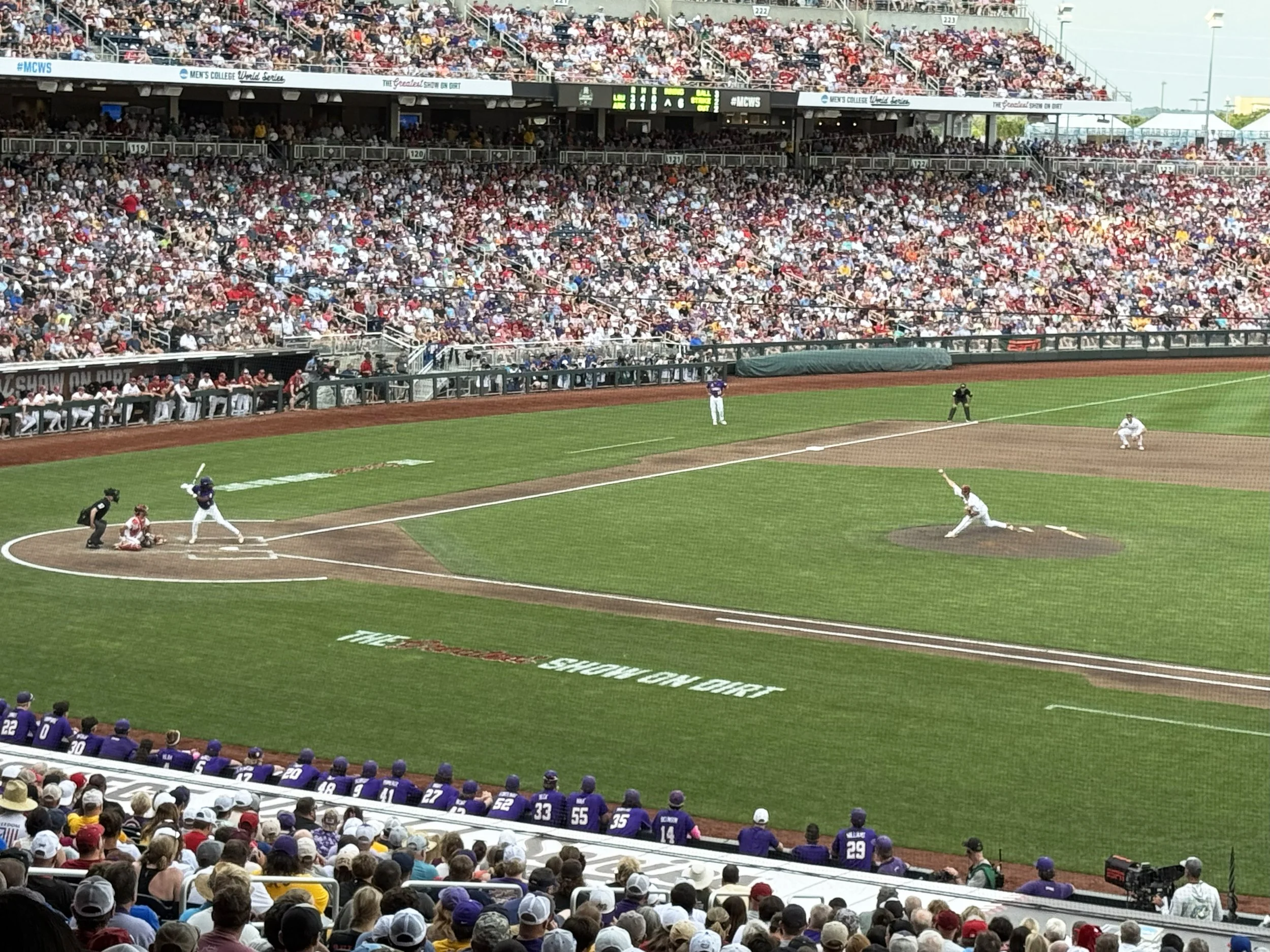
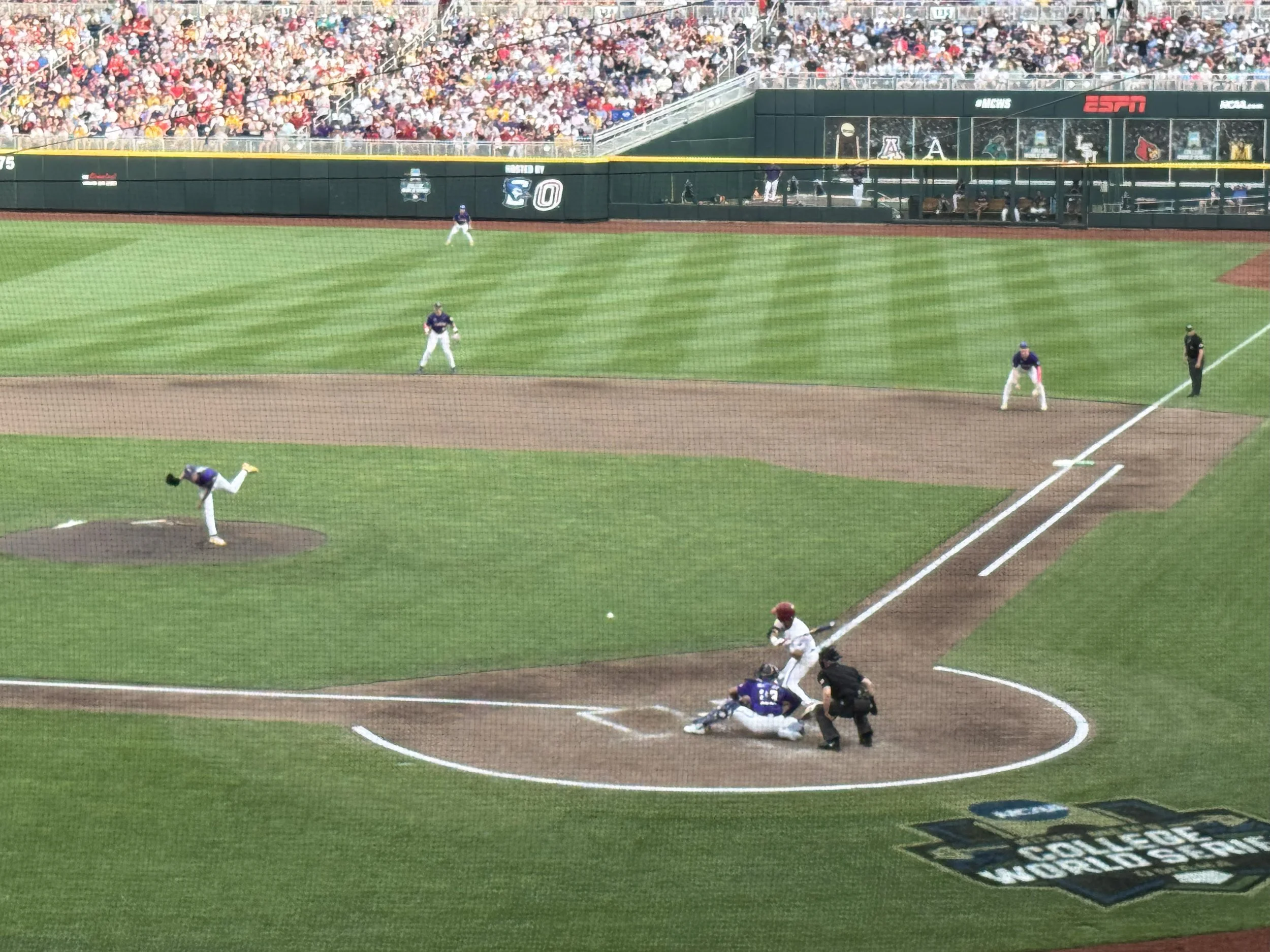
LSU regained its three-run lead it in the eighth with a pair of hits, making it 4-1 Tigers.
I took a walk around the outfield as Arkansas looked for a late-inning comeback.
Outfield food vendors were still going strong as the end of the game approached.
Back on the Arkansas side of the field, I ran into Razorbacks mascot Big Red, who looked as lean as his team’s prospects heading into the ninth.
Arkansas left fielder Charles Davalan led off the ninth with a single — just the fourth hit of the game for the Razorbacks. But LSU closer Casan Evans — who finished the season with a sizzling 2.05 ERA in 52 2/3 innings — slammed the door shut on the Razorbacks. LSU came away with the 4-1 victory.
In the ensuing days, Arkansas would work its way back up through the loser’s bracket, beating both Murray State and UCLA to earn another shot at the Tigers in the national semifinals. LSU prevailed a second time, 6-5, then went on to sweep Coastal Carolina in the final series to claim its eighth national championship.
As for us, we had done it — 20 ballparks in 21 days. Dad and I felt equal measures of exultation and exhaustion. But we weren’t quite done yet.